

Each weekend when biologist Krissa Skogen was a kid, she went with her family to a lake in western Minnesota. The six of them camped in tents on a small property where there was no cabin, no running water, and not even an outhouse—just a small shed for storing fishing rods. There, Krissa developed an early taste for nature and for something even more important: freedom.
For entertainment, her family would go to nature centers where Krissa gravitated toward the plant identification books. “I’d try to figure out what was what based on the drawings. It’s hilarious to think about now, because it was so hard.” The books, she said, offered only vague, general categorizations that made it impossible to actually identify the species. “But there’s no question that’s why I do what I do today,” says Krissa. “It was spending so much time outside and having the opportunity of hours on end to figure something out.”
Today, Krissa researches nocturnal pollination and what makes the scent of a flower at night so marvelously alluring—to insects, animals, and to us.
“The cool thing that connects the scientific community is we’re all working in our own little ways to advance knowledge and our understanding of the world.”
– Krissa Skogen, conservation scientist at the Chicago Botanic Garden and adjunct professor in the program in Plant Biology and Conservation at Northwestern University.
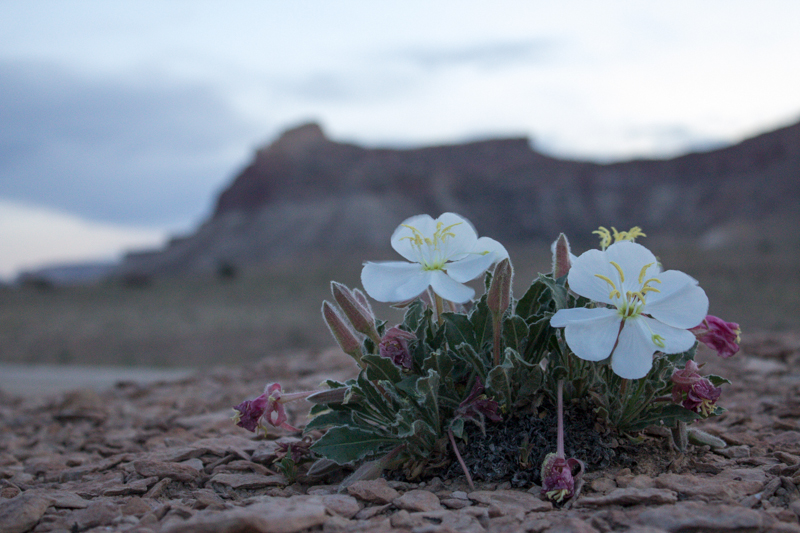
The fragrant and fabulous evening primrose, one of Krissa’s study subjects shown here blooming in the nighttime air of the arid West. Photo: Skogen Lab 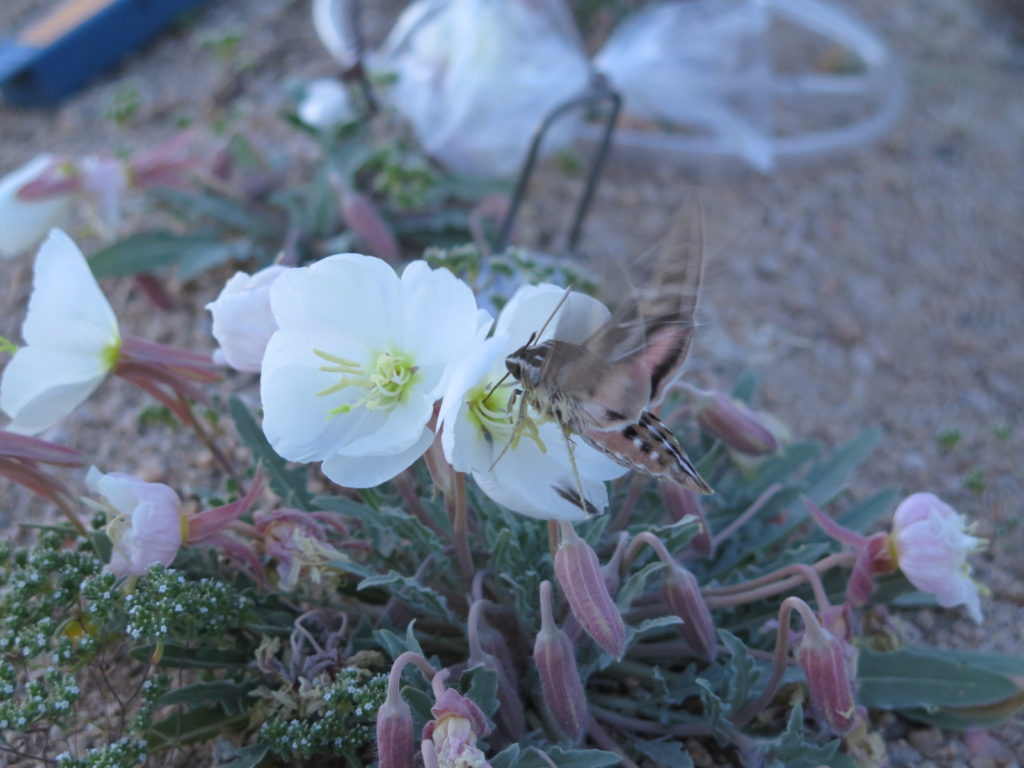
The hawkmoth is one of the pollinators that visit the evening primrose in the evening, after the sun goes down. Photo: Skogen Lab

Riddell: Most of us have a time of day when we’re at our best. For me, it’s morning. All the hard stuff, I try to cram it in before noon because at least I think that’s when I’m at my most brainy and brawny. Night people have always been a mystery to me because I’m so non-functional in the wee hours of morning. People who prefer late night as a reasonable time to vacuum the living room or write their novel have always held a special allure. It’s almost like those night people by finding a way to make use of late hours, of that time when I’m asleep. It’s as though they found a hidden resource or a buried treasure. And even though I know where that treasure is, I still just can’t access it. I’m Jill Riddell. This is The Shape of the World.
Skogen: I’m particularly interested in what happens at night.
Riddell: That’s Krissa Skogen. She’s a conservation scientist at the Chicago Botanic Garden.
Skogen: My research focuses on pollination, biology, and plant reproduction. Most of my work in the last 10 years has focused on nocturnal pollination.
Riddell: Our human species is classified by scientists as diurnal. That means it’s daytime when people do most of their activities, and it’s dark out when we do most of our resting. To us, this seems normal. Creatures are busy by day, slow down at night. But we have a very skewed data set. In the animal kingdom that we live in, being diurnal is so unusual as to be downright outlandish. For every five species of mammals in the world, only one is like us, active by day. And the plant world, tons of flowering plants are at their busiest by gleam of moonlight. Opening wide commodious blossoms, exhaling perfume, attracting pollinators, all after the sun goes down. That’s when Krissa’s favorite pollinator, the hawk moth comes out.
Skogen: What’s cool about these insects is that if you’re fairly still, they don’t notice you. And so you can just sit quietly in front of a plant, watch for pollinators to come. I mean, it’s kind of amazing. The sun starts to set, and then kind of all at once, the hawk moth just show up on the scene. And they fly in, they hover in kind of in front of your face within like two or three feet of where you’re sitting. And they unroll their tongue and insert it into the flower and drink nectar. Some of them are hilarious because they’ll fly around with their tongue unfurled and sometimes they’re like eight to 10 inches long.
Riddell: Eight to 10 inches long?
Skogen: Yeah.
Riddell: Clearly I need to get out more at night. So Krissa and her team, they’re out in the air at American West. It’s nighttime. And they’re watching this urgent sex that’s happening not between two people, who are kind of different from one another, and not merely between members of two different species, which already moves us into a territory, but between two different kingdoms. In the classification of living things, plants are on one side, animals are on the other. They’re really different. Yet something intensely sexual is unfolding. And on the night Krissa was describing, it was happening right in front of her eyes. She sat a few feet away, observing like an Alfred Kinsey of the plant world.
Krissa, before I delved into your research, I had never really thought about how we think of something having an attractive scent as being a way to attract a mate, but a flower doesn’t smell nice so that it can lure another flower into mating with it. A flower smells nice to attract animals, and that’s just so strange.
Skogen: Yeah. Yeah. It’s very cool. Plants are sedentary. They can’t get up and move. And so what many, many plant species and about 90% of plant species that produce flowers globally attract pollinators to do the work of moving pollen from one plant to another in order for reproduction to happen. Animals can just go find a mate. Plants can’t. And so they have to co-opt a pollinator in this really important task of reproduction.
Riddell: What is it like for you and your team to go out there at night and sit in the dark and do this work?
Skogen: I love field work. It’s one of the main reasons why I’m a biologist. We get to a site, we park the truck, we hop out, we run around like crazy, set everything up, and then everyone grabs a clipboard with a data sheet on it and a pencil and a headlamp. It’s starting to get dark and you’ll go sit in front of your plant and then you have an hour to just sit and just take in the landscape. You’re focused on the plants or a couple of plants immediately in front of you. The chaos is over and you can just really like take everything in and enjoy. And then when the pollinators come in, it’s very exciting. There’s this frenzy of about 20 minutes after the flowers open where you get a lot of visits. You sit down in front of your plant and then what you do is you record… If something visits a flower, you record what it was.
So was it a bee? Was it a hawk moth? Or it could be a bird, could it be a bat, geckos. There’s so many fantastic examples of really wild pollinators.
Riddell: Right. We think of plants as being so small and flowers being so delicate, the idea of a gecko coming along, pollinating it isn’t the first thing that pops in our minds.
Skogen: Yeah. Yeah. When people think of pollinators, they do not think of moss. They think of things that fly during the day. Most people think of bees and honeybees, or they think of butterflies. Not many people think, “Oh yeah, how does a moth make its way in the world? What is it eating?”
Riddell: You’re right. I think our frame of reference as human beings is because we’re mainly diurnal. We only think of the things that are active during the day.
Skogen: Yeah. So what the pollinator gets out of the relationship is a resource it needs. So for the most part, pollen and nectar are the important rewards. So the pollinators are looking for food and the plants are looking for reproduction.
Riddell: So if you’re trying to better understand precisely what each gets out of the relationship, then what data are you collecting?
Skogen: What we’re doing and what we’ve done all over the Western US is we’ve collected data on flowers. So flower size, shape, color, how much nectar they produce and how much sugar is in that nectar. We also collect floral scent samples. So to do this, you have to go where the plants are.
Riddell: So I have to ask, how do you collect something scent? Are you only collecting sort of the chemicals that make up the scent or is there a way to actually preserve the smell itself?
Skogen: Usually it’s often like a frantic frenzy of organized chaos. We have all of our equipment in our truck and we scout the area, try to figure out how many plants are there and which ones are going to flower that night. So to sample floral scent, we use a couple of things that people are very familiar with. So first we’ll take an oven bag that you would use to cook a turkey.
Riddell: Like one of those kind of aluminum foil looking like things. Okay.
Skogen: Yeah. So they’re made out of plastic that doesn’t have a smell.
Riddell: Okay.
Skogen: Then what we do is we’ll put the oven bag over a flower bud that’s starting to open. We’ll secure it to the bottom of the flower and then in the other end we insert a filter that we’ve created that traps the volatilized compounds that create the fragrance that we smell. You can kind of think of it like a hard candy wrapper and where the candy is the flower is and on one end is the filter and then we hook some tubing up to the filter.
The other end of the tubing gets attached to a small handheld air sampler that pulls air through the filter at a constant flow rate. And this whole apparatus is set up on a number of different plants and we have to get there at the right time so that the timing is right. We don’t want to get there too late because the flowers will have opened and we’ll have missed the opportunity to get a lot of that data. The ultimate goal is to determine which different compounds create the floral bouquet or the smell that you smell when you smell a flower, say a rose or something like that.
Riddell: So scent is a way flowers attract insects and animals, an example of mutualism. Both get something good out of it, but you also study antagonists. What’s an example of that?
Skogen: So an antagonistic relationship as opposed to a mutualism would be one where one of the two interacting organisms benefits and the other one does not.
Riddell: They suffer harm at the hands of the animal by being eaten or having their seeds taken and not redistributed in a way that’s beneficial to them.
Skogen: Right. So my work, the mutualism is the interaction between the plant and the pollinator. And the antagonism is the interaction between the plant and another organism that maybe is an herbivore. And then there are a number of different examples of insects and other animals that will eat seeds or eat fruits. And if they eat the seeds, then those seeds won’t go on to grow, they won’t reproduce themselves. And so that’s sort of the evolutionary dead end in some ways for that individual.
Riddell: I’m interested in this idea that something that’s meant to attract something good, a pollinator can also end up attracting something terrible, an antagonist. And it made me think, do you know that line from F. Scott Fitzgerald? The test of a first-rate intelligence is the ability to hold two opposed ideas in mind at the same time and still retain the ability to function.
Skogen: Yeah, that’s so appropriate here.
Riddell: It seems like it. I mean, you’ve got the really good thing and the really, really bad, terrible thing all wrapped up and being attracted to the same scent. And one of the things that I’ve learned is that even a positive event is sometimes embedded with things that aren’t all good. So like the birth of a child is a really fantastic thing and you sort of have to only talk about the really fantastic part, but in fact, underneath of it are all those incredible stresses that come with being a mother. And I just wondered, like you spend so much time sort of with this paradoxical trade off that the plants are doing. Does it affect at all your view of life to sort of think about something like that, to be able to hold that sort of paradox of good and bad existing within the same thing?
Skogen: Yeah. I think it’s a really real experience and maybe, I guess what I find really interesting and what scientists in my field have focused on for most of the maybe last 100, 150 years is the positive, is pollination and only more recently have scientists started looking at other things that maybe having a really large impact on an interaction that we see. And I think the parallel, a really nice parallel is that that’s just how life is. We tend to focus on the good things and the positive things in life, the successes, the joyful moments. Even when we run into someone we haven’t seen in a long time, no one goes into the nitty-gritty or even like rushes over the terrible things or the not so great things that have happened since you’ve seen someone last. Instead, you hit on the highlights and to really experience the full life and really understand someone in a deeper way and in science, the biology in a deeper way, you have to look at the nuanced relationships and interactions and the things that happen over time that result in something pretty amazing.
And in my work, everyone, whenever I talk about what it’s like to be in the field and how you collect the data, they get excited. But when you talk about little tiny larvae or little tiny caterpillars that look like maggots and they’re eating seeds inside of fruit, most people are completely disgusted. They don’t want to hear about it. They don’t want to think about it, but it’s been fun for me to kind of come at the systems that I’ve been working in from this different perspective to try and understand what’s the balance. And in biology over evolutionary time, the things that persist are the things that win most of the time or when the good happens most of the time. And I think over someone’s life, the things that really make them who they are, are the good and the bad.
Riddell: Yeah. I’ve been interested in that issue of how we tend to favor animals and plants that are very showy in some way and very apparent in some way. So the flower with a scent we find to be beautiful, but also I’ve been interested in the fact that camouflage and being hidden can be a great asset for a plant or for an animal. When you’re doing your work or when you’re thinking about your work, is there a metaphor you like to use that the scientific work reminds you of?
Skogen: Yeah, I guess so when we’re doing field work and we’re not getting a lot of sleep, the team joke is sleep is for the week or we can sleep when we’re dead, which is like just a joke kind of because like you really want to get the data and you want to be, you don’t want to miss the opportunity to collect the data that you’ve worked really hard to go out there and collect.
Riddell: Right. You’re in the field for such a short time, you don’t want to blow that time.
Skogen: Yeah. Yeah. I might equate the work that scientists do to the work of a detective maybe.
Riddell: Interesting.
Skogen: Yeah, you’ve identified a question that you don’t know the answer to and your job is to ask follow up questions and try and find the evidence to lead you to an answer that no one’s asked before or been able to nail down the answer to yet. For me, it’s fun because it just requires you to think broadly and be creative and consider problems from different perspectives. And the process for science, you make observations, you come up with a question, you go to the scientific literature to see if anybody’s asked that question yet, and then you do what it takes to answer the question. And so you may find yourself going down a path you hadn’t anticipated before.
And for me, for example, like I for a long time was like, I’m a pollination biologist and if someone had told me 10 years ago that I would be really excited to crack open a immature fruit of a plant and find a little caterpillar in it that really looks like a maggot and I would be really excited and talking about how cute that little caterpillar is, I would have been like, “No way, that’s not what’s going to happen.”
Riddell: Really? That wasn’t your vision all along?
Skogen: No, no, no. So a lot of the time we just follow the question and see where it goes.
Riddell: It is a little bit like detective work also in that you have to be really careful that you’re not making assumptions that aren’t being adequately challenged. You need to make sure that you’re really testing it, making sure that that’s the right answer and responding to what the data says, even if you end up finding out that your original assumption was wrong.
Skogen: Yeah. And that’s something I talk about with students a lot because often you have a hunch about what you’re going to find and what makes sense to you. And sometimes if the data don’t support your hypothesis, students will be disappointed. But I always point out, well, now we know and we didn’t know before and that’s still really exciting. Whether or not what you thought was happening turns out to be the actual case, like no one asked that question before and now we know and arriving at a conclusion that you hadn’t anticipated can sometimes be frustrating or annoying or disappointing, but also really exciting because then you have to start going down an entirely different path to try and figure out, well, well, why and why did I assume it was going to be this way and why wasn’t it?
Riddell: That’s right. And if it isn’t that way, then what way is it? So is there a thinker or a writer about science whose work you particularly admire or somebody that has really sort of shown a light on what you do from another perspective?
Skogen: Yeah. There’s this great book called Lab Girl by Hope Jahren and it’s an autobiography. It’s a fantastic read and it’s a great firsthand account of what it’s like to be a scientist, but also what it’s like to be a woman in science and the-
Riddell: And a botanist.
Skogen: Yeah, yes, yes. And for people to get excited about plants and I mean, I would have read it even if it wasn’t about a botanist.
Riddell: I loved all the way she started each chapter with these incredible observations about plants that were new and fresh for me.
Skogen: That book really resonated with me from the beginning because I grew up in Fargo, North Dakota and she is from a small town in Minnesota. And so the images of the cold winter nights and all the snow, I just felt like, oh, we had similar childhoods to some extent.
Riddell: Did you have an early experience with nature that made you curious about plants and want to know more?
Skogen: I’m from like a Brady Bunch family of sorts. So I have a half sister and two stepbrothers and my mom’s parents bought a small piece of property on a lake in West Central Minnesota. There was no cabin, there was an outhouse, a little shed to put our fishing rods and like life preservers and things in. And we pretty much every weekend, my entire childhood car camped on this little property and there was no running water, there was no electricity and we were just set free to keep ourselves busy. And so we spent a lot of time, of course, swimming and fishing and those sorts of things, but also just like poking around.
Riddell: Did you ever have a particular experience with a flower or a plant that made you curious?
Skogen: We would go to like nature centers and I would gravitate towards the plants and flower identification books and then try and figure out like what was what based on the drawings, which is hilarious now because a lot of the books that they sell aren’t that.
Riddell: They’re hard to figure out what the flowers are from the books.
Skogen: Right. They’re hard and they’re like just this like kind of gross categorizations of like, here’s a sunflower and here is a fern and it didn’t really get down to what the actual species was, which of course it didn’t.
Riddell: And then the sunflower that you’re looking at doesn’t look like that sunflower, right?
Skogen: Right. Yeah. Yeah. But I really think that like spending so much time outside and just having the opportunity to have hours on end to just figure something out, like there’s no question in my mind that that’s why I do what I do today.
Riddell: How did you get from the place where you were interested in plants in general to going to grad school and how did you pick a particular plant to study?
Skogen: So when I went to grad school, what I wanted to do was I wanted to find a system that I could ask different kinds of questions and to gain the experience of collecting genetic data and looking at population genetics. And then I wanted a component that focused on plant reproduction and then I also wanted to collect data to try and understand why some species disappear really quickly and others don’t. And so what I did was I tried to identify a species that needed these data and these answers in order to help conserve them in the future. I didn’t really care what it was and we found each other, I guess.
Riddell: What was the plant you started with?
Skogen: For my PhD, I focused on a plant species that’s pretty scrappy and whenever I would explain what I worked on to other botanists, they would say, “Oh, that? Why would you study that like terrible genus of like weedy, annoying, the genus is Desmodium.”
Riddell: Are those the ones that are called tick trefoil?
Skogen: Yes.
Riddell: People often call them that because they stick to you like ticks.
Skogen: No one gets excited about Desmodium, but I did. And I liked spending time on something that most people were going to just look past and it deserves our time too and it has a story to tell, even though most other people think of it as a nuisance.
Riddell: So the plant was understudied and you were excited to step into the breech?
Skogen: Right. Yeah. Yeah. In some ways, well, I selected the species in the winter and I didn’t like meet it in person until like May. And so I was already committed to it before like sight unseen, total blind date and now we know a lot of … Well, I know a lot about it.
Riddell: So it wasn’t as though you were walking through an area where it was growing and had it stuck to your pants and had an aha moment of wondering more about its life history.
Skogen: Right, right.
Riddell: But after you spent all that time with this underloved, underappreciated tick trefoil, how did you move from that to studying evening primrose?
Skogen: I felt kind of like a sellout because evening-primroses are like, some of them are just really obnoxiously gorgeous and the flowers are big and they smell amazing and the plants are beautiful.
Riddell: And they’re pollinated by these cool hawk moths.
Skogen: Yeah. Yeah. And it just felt like I had been fighting for an underdog for six years and then I like sold out to this charismatic megaflora species or like the poster child of nocturnal pollination out west and you know
Riddell: Right. You even went to a glamorous location in Colorado.
Skogen: Right. And my friends and family who aren’t scientists and aren’t gardeners, they had heard of evening-primroses, none of them had heard of tick trefoils. And so I felt a bit like a sellout.
Riddell: But sometimes we outgrow things just because you once loved tick trefoil didn’t mean you’d sworn never to look at another plant. I admire the fact you knew it was time to move on.
Skogen: It’s not healthy to stay confined to this idea of what I thought I would do or what I thought would make me happy. You could think something is for you or you’ve done it for a really long time and the excitement has worn off. People think if I quit, it’ll be embarrassing and I will have let someone down. But the reality is you’re moving forward in a way that acknowledges how you change over time.
Riddell: I think that’s really true. I tell that to my own children that evaluating whether something is a success or failure isn’t dependent on how long it lasts and not every relationship is going to last for 70 years and not every job you take is going, you’re not going to stay in that exact same job for 70 years. And the fact that it didn’t last for your entire lifetime doesn’t make it a failure.
Skogen: Right. It goes for relationships, but also in your work, a lot of us have difficult things that we do and in science, writing grant proposals, getting them funded, applying maybe for fellowships and receiving them, writing scientific papers, having them accepted and then published. It’s very competitive, but lots of different fields are competitive. I don’t think science is unique in that way at all, but I’m a better scientist for the things that didn’t work out like I wished they had in the moment. If I got every grant I ever applied for, I would take that for granted. And I’ve learned a lot from the things that didn’t work out.
Riddell: Yeah. I tell my students who are trying to… They’re writing students and they’re trying to get published that if somebody says no to them, it just means it doesn’t fit with their plans right now. It’s not a statement on your worth or value or even the worth or value of your work, but what you’re writing right now isn’t what they’re publishing.
Skogen: Right. Yeah. And that—
Riddell: And the same is true in science, right? Sometimes there’s nothing that’s not that your project isn’t worthy, but the place that you’re applying for your grant for is focused on something else right now.
Skogen: Yeah. And I think that’s where creativity comes into play too. You have to think creatively, not only about like how to test your question and pull together the right kinds of data to be confident in what you find, but also you have to be creative in pitching your story to funders and showing them why it’s interesting and how it’s relevant to them and what they want to spend their money on. And then when you go to publish it, convincing the editor and the reviewers that other people will benefit from what we found out. That’s kind of all it is telling a story and trying to get other people excited and interested.
Riddell: It’s so much more than just thinking through what your question is as a scientist.
Skogen: A lot of times I think, man, getting a PhD, being a scientist is such a selfish endeavor because I can ask any question I want. I can just find the things that I think are really exciting and cool and interesting, and then collect the data and find out what’s going on. However, I have to convince someone else that the thing that I think is really cool is also interesting and worth knowing.
Riddell: And beneficial in some way.
Skogen: Yeah. And I think that’s the cool thing that connects the scientific community is we’re all working in our own little ways to advance knowledge and our understanding of the world and we’re all telling our stories and showing each other how what we’re working on is relevant to what somebody else is working on. That’s probably the best part, being able to share something that you really love and you enjoy with people who also think it’s really awesome.
Riddell: Thank you so much for coming in, Krissa. This was great.
Skogen: Thank you so much. It’s been a lot of fun.
Riddell: I hope this conversation with Krissa Skogen inspires you to explore the dark. Even if it’s only on your own back porch or front stoop, make a point of stepping outside sometime this week and look and listen. You might be surprised by what you see. Next week, worm-eating mice and dense mossy forests.
Speaker 3: And if you stand in one place and you kind of bounce up and down, the trees around you bounce with you. It’s just this bizarre, cool habitat.
Riddell: Until then, enjoy your nights. The Shape of the World is about nature and people and the world we share. It’s a production of the Office of Modern Composition, a business that creates compositions and fosters composers. If you have a story to tell, the Office of Modern Composition can help. They can go all DIY and teach you how to write and produce the story yourself, or they’ll do the whole thing for you. Either way, you will end up with a permanent archival piece that presents your ideas and experiences. The Shape of the World is produced in the vital, vigorous, and beautiful metropolis of Chicago and the Prairie State of Illinois. You can find Shape of the World on Facebook and Instagram and on the website, shapeoftheworldshow.com. There, you’ll find a photo of a hawk moth, a link to the book Krissa mentioned, and a drawing of Krissa by the artist, Rose Curly, and much more.
Shape of the World’s producer is Isabel Vasquez. The theme music is composed and performed by Brad Wood. Thank you to today’s guest, Krissa Skogen, and the Chicago Botanic Garden.

