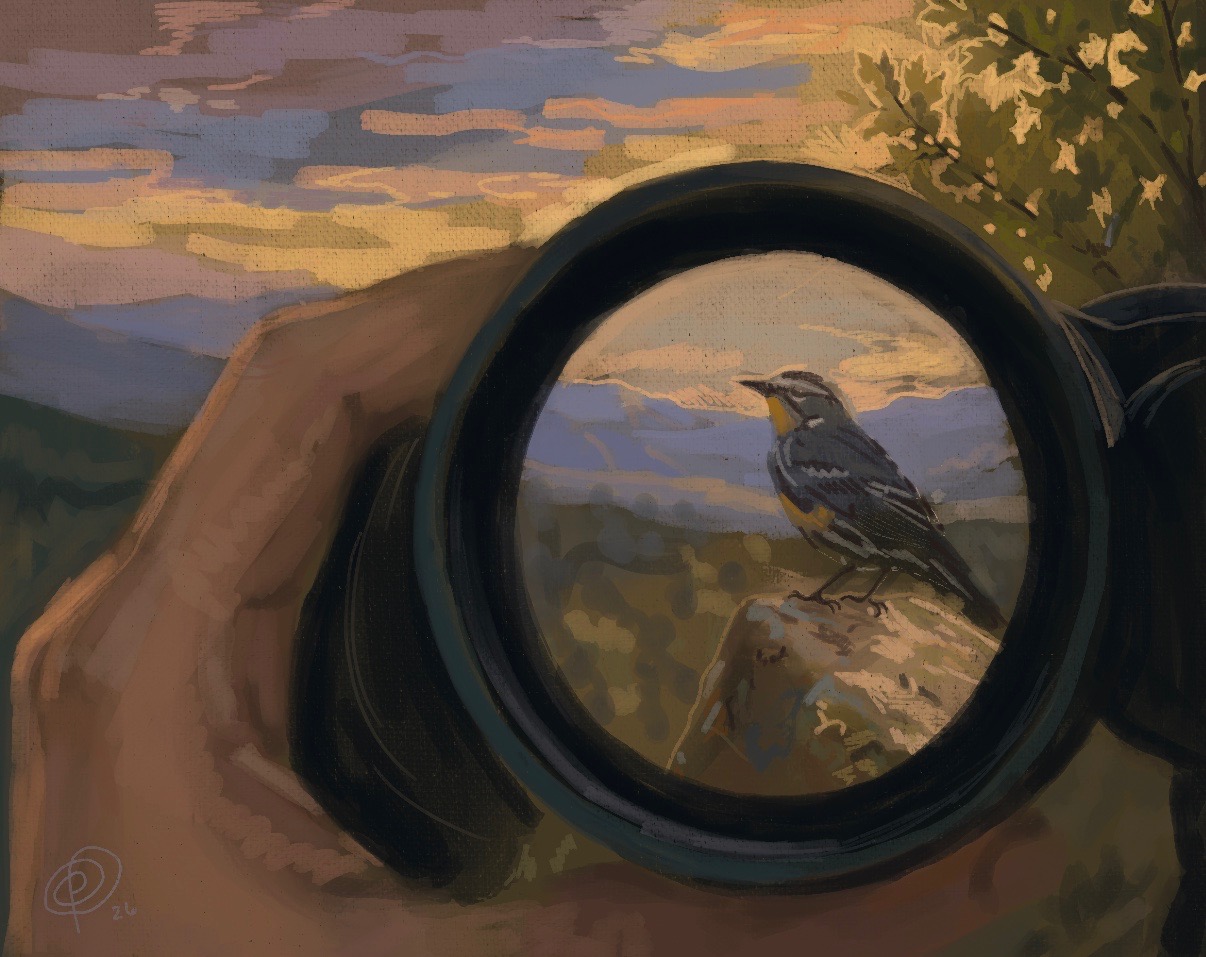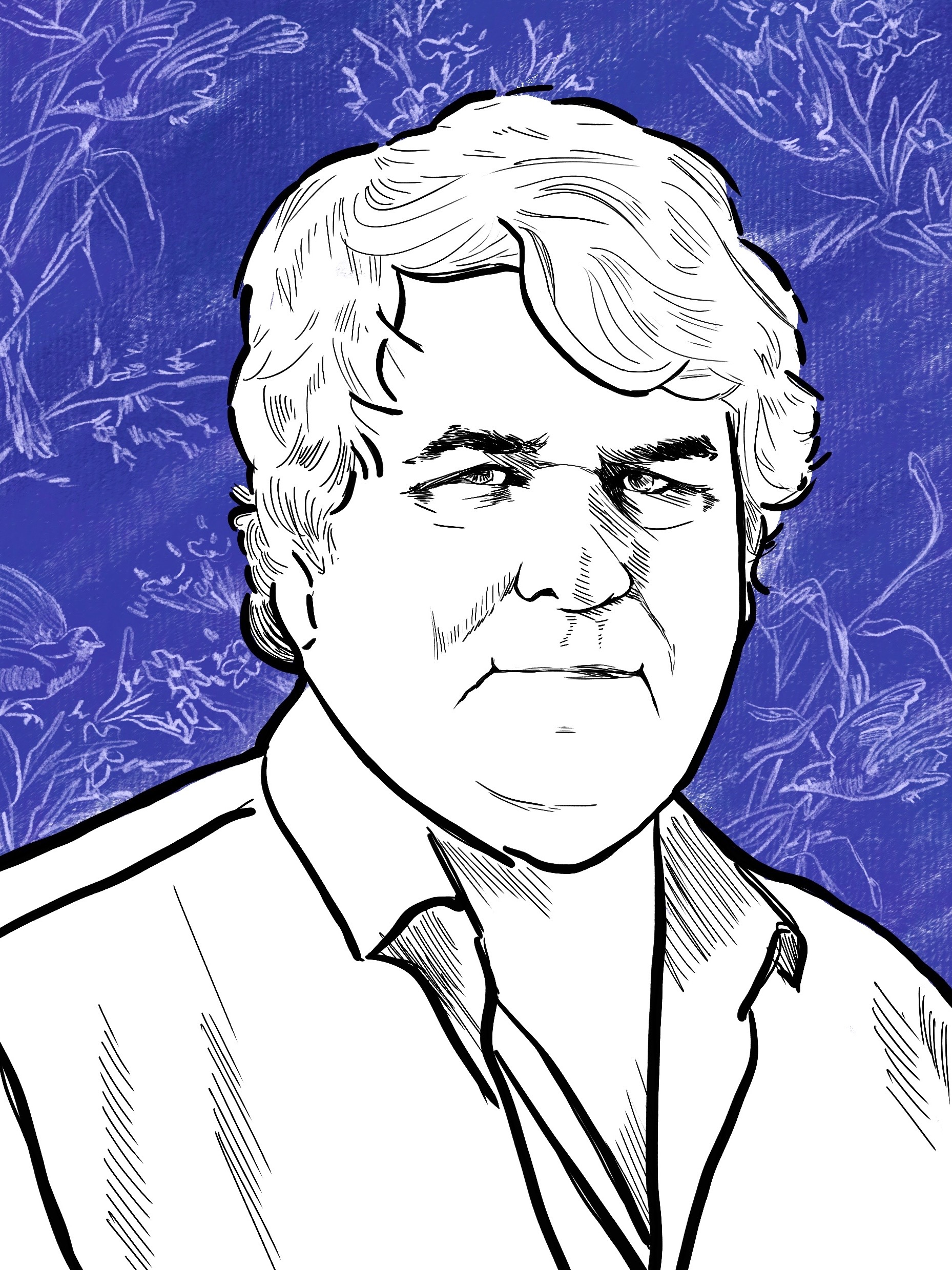
Ornithologist Doug Stotz is a key player in the Field Museum of Natural History’s strenuous effort to safeguard threatened landscapes, galvanize community stewards, and advance action-oriented science research. Doug’s long tenure at the museum is on the verge of changing, so we at the Shape of the World wanted to be sure that before Doug formally retires, we managed to capture his stories and insights.
Over his lifetime, Doug has seen (so far) roughly 3,750 different bird species. That’s over one third of all bird species known and named. Doug is in at least the top 1% of birders worldwide, and perhaps more like the top 0.1%. In the 1970s when Doug got started, bird watching was still an unusual hobby, unlike today. (Currently, in the United States, 96 million people characterize themselves as birders or as someone who’s interested in birds.)
For decades, Doug has worked at the Field Museum’s Keller Science Action Center. Keller uses museum science and the museum’s collections and data to support conservation efforts mainly in two places: the tropical forests of the Andes-Amazon region, with its famous diversity of species and cultures, and in and around the museum’s homebase of Chicago. Altogether, the Keller Science Action Center has protected over 29 million acres of natural habitat.
As is common at natural history museums, Doug’s retirement marks a change in formal employment at the Keller Science Action Center, but the event does not put an end to Doug’s scientific contributions. Like many other esteemed specialists who’ve carried out their life’s work within a museum, Doug now has a less formal but still ongoing relationship with the museum—one that encourages him to continue to study birds and collaborate with museum colleagues.
Doug is one of the authors of Neotropical Birds: Ecology and Conservation (University of Chicago Press, 1996), which today stands as a landmark reference on the ecology, distribution, and conservation of bird species from Mexico to South America. He serves on the Mayor’s Nature and Wildlife Committee, and he is a member of the Field Museum’s monarch team, an ad hoc group that ensures healthy habitats for pollinators in Chicago.
“Almost everything is about birds, and almost every bird has something of value to teach us.”
– Douglas Stotz, Ornithologist and Senior Conservation Ecologist at the Field Museum of
Natural History
Learn More About Urban Bird Collisions
Chicago sits along a flyway that transports 40% of North America’s migratory birds from south to north in the spring and back again in the fall. But the city’s tall glass buildings and light pollution pose a major threat to the safety of birds in transit. Due both to Doug’s efforts and those of other researchers at the Field Museum, and because of Doug’s role in the Mayor’s Nature and Wildlife Committee, Chicago became the first city in the United States to implement a policy that encouraged tall buildings to turn off their lights during migration seasons. That program, called Lights Out Chicago, started in 1999. The Chicago Bird Alliance and other environmental players also played strong roles in getting this major achievement initiated and over the finish line—it was a successful team effort.
Lights Out Chicago reduced the problem, but it’s still far from being entirely solved. For better or for worse, the city has become a national leader in studying and tackling the problem of urban bird collisions—mainly because there are still many, many collisions occurring.
If you wish to delve into this more, you can visit a great exhibit on display in downtown Chicago, Flyway City: Architecture for a Flourishing Ecosystem. The exhibit was designed and co-curated by Jeanne Gang of Studio Gang (she was a previous guest on this podcast), along with Openlands (an environmental conservation organization) and the Chicago Architecture Center.
Other bird-related programs happening in Chicago
Events: The Urban Birding Festival (happening September 18th–20th in Chicago, hosted by the Chicago Bird Alliance).
Artist Interventions: Watch this really cool YouTube video about artist Holly Greenberg’s project to create a fabric artwork that’s kind of this big ‘carpet’ of birds. It will eventually be a travelling art piece that specifically exists to raise awareness about the toll building collisions are taking on bird populations. You can actually help her work on it.
Another Chicago artist, Alice Hargrave, has a project, Last Calls / Pink Noise, that transforms recordings made of bird calls into visual representations. She, too, is is highly concerned about bird collisions with buildings and wishes to call attention more generally to the plight of birds. Watch this video to learn more.
Note on “Rapid Inventories”:
In the episode, Doug mentions the Field Museum’s “rapid inventories,” and neither Jill nor Doug explained much about those, so here goes! Originally called “Rapid Biological Inventories,” these surveys initially focused on plants and animals only, but soon expanded to include social elements. As a first step, researchers engage in conversations with local communities and solicit both their involvement in decision-making and in the communication of findings. The nomenclature now is either “Rapid Biological and Social Inventories,” or, as Doug called them, simply “Rapid Inventories.”
The Field Museum launched its conservation-oriented Rapid Inventory program in South America in 2000. It’s an approach that uses inventories as the beginning of conservation efforts rather than the end of research, and the concept and technique have been replicated by others. Since 2000, the Field Museum has conducted more than 30 inventories, primarily in South America but also China and elsewhere. These helped catalyze the protection of millions of acres of habitat.