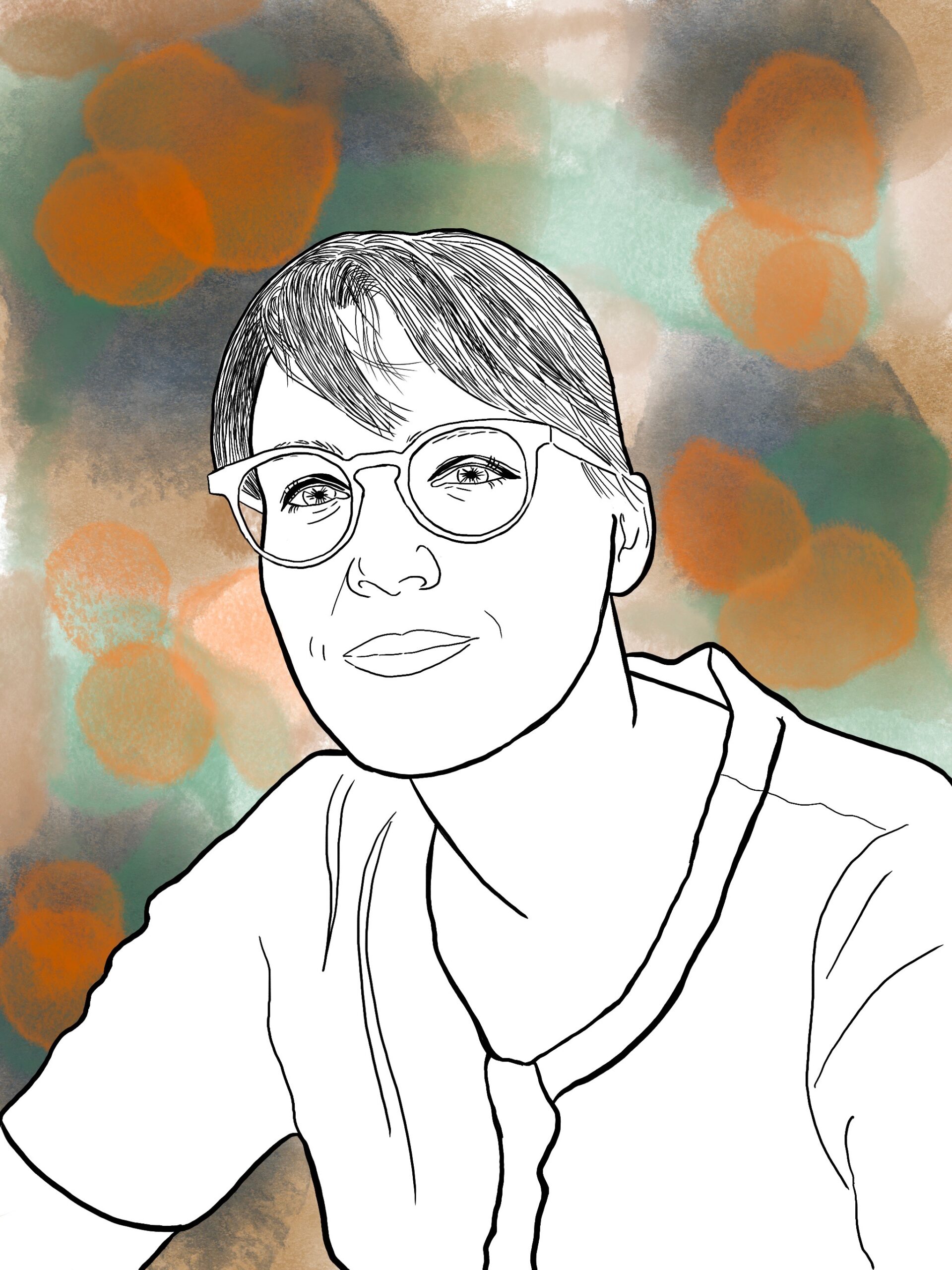
Sophie Lucido Johnson, cartoonist for The New Yorker and the author of Kin: The Future of Family.
Jill Riddell speaks with her colleague, Sophie Lucido Johson, about comedy, community, and the social science of friendship. In her new book, Kin: The Future of Family, Sophie encourages us to reenvision “family” as a much larger network — not just genetic relatives but also neighbors and friends.
We are living in an era that has the highest reported levels of loneliness, yet many forces encourage us to occupy more and more physical space and to spread out far apart from one another. In this episode, Sophie describes how taking up less physical space can be a radical act of restitution and care — both for ourselves and for the planet.
“Humor feels really good, and I think it’s important for people to do things that feel really good. Otherwise, you mess everything up for everybody else.”
– Sophie Lucido Johnson, cartoonist for The New Yorker and the author of Kin: The Future of Family
Learn More About Sophie
Buy and read Sophie’s books. The one most discussed in this Shape episode was Sophie’s most recent one, Kin: The Future of Family. That link will direct you to Amazon, but we’d be remiss if we didn’t mention how much more fun and aesthetically pleasing it will be for you to buy Kin at your local bookstore, or to ask them kindly to order a copy for you. (And if you do the latter—you get to have a social interaction! Bonus!)
Although those of us who make the Shape podcast all love Kin very much, Sophie’s new book didn’t showcase her funny cartoons and wonderful drawings quite as much as her other two previous books did. So here you go—links to those two:
And one more! Audible commissioned Sophie to write an Audible Original, an audiobook called Love Without Sex—that one is available only on their platform and is well worth it.
Sophie has an outstanding Instagram and a superb, thoughtful (and yes, funny!) Substack called “You’re Doing a Good Enough Job.” You can also see more of her work on her website.
Transcript of This Conversation
[Shape theme music starts]
JILL RIDDELL: Welcome to the debut episode of Season 7. Typically on this show, I interview a person that I’ve never met before, somebody whose work I’ve admired only from afar. And I love doing that. It’s great to meet somebody new and understand better how they view the world we live in, how they think about cities or what they know about some aspect of nature. But today you’re going to be hearing, and honestly, it may even feel like you’re overhearing a conversation between me and a person whom I actually know very, very well. Because the guest for this episode is one of my colleagues and also a friend whom I work with at the Office of Modern Composition. The Office of Modern Composition, or OMC as we call it around here, is the entity that produces this podcast and also the Small Gold Objects Substack. And know OMC is not an invention of our imagination, something made up just for the show’s final credits. OMC truly does exist inside an actual physical space on the 20th floor of this art deco building on Michigan Avenue in Chicago. And inside this happy little hive, there are three of us writers who use that space to compose our own work. We each have our own individual projects, books, articles, cartoons, essays, podcasts. And we also work as a collective to make that OMC magic happen for other people too. We take on clients that we help with their writing projects and we host things like workshops and art shows and co-writes. So I think today’s conversation is going to be a blast. Welcome to The Shape of the World. I’m Jill Riddell.
[Shape theme music fades]
SOPHIE LUCIDO JOHNSON: Hi, I’m Sophie Lucido Johnson. I’m the author of Kin: The Future of Family and a cartoonist for the New Yorker Magazine and a teacher at the School of the Art Institute of Chicago. And I live in Chicago and I have chickens and I have bees.
Johnson: Thank you, Jill. I am so excited to be here.
Riddell: Sophie, I’m really excited to have you on the show. And as you know, Shape of the World is a lot about cities and nature and humans. And I actually see you as a nature writer, even though you are probably more famous for your first book on Polyamory and your current book, which is really about how we humans can live together and create kin and families that are intentional. You write about a whole lot of things, but I’m still sticking by my guns. I still see you as a nature writer. Does that strike you as fair?
Riddell: The Holy Trinity.
Johnson: And I was like, oh, that’s actually … Those are not things I write about that often to be truthful. I mean, I have a book about polyamory, but I don’t really write about it very much. Parenting, I don’t feel like I have any right to write about. I’m terrible at it and I don’t know anything about it, except that I’m living it, but I feel like, oh God, I can’t write about it. What I mostly write about is the seasons changing and how that affects our animal bodies. And that feels like the center of everything, all of the work that I do and make. But I strongly identify as being a nature writer.
Riddell: Yeah. In addition to your interest in nature, you also have some experience with the other topic of the show, which is cities. You’ve lived in a few different American cities in Portland, Oregon, and New Orleans and Chicago. In addition to liking nature so enthusiastically, do you also have a love of cities or is that just where the jobs happened to be, so that’s where you ended up?
Riddell: What do you like about them?
Riddell: And goofy.
Johnson: Yes.
Riddell: And there’s opportunities to just see crazy things just that happen on a regular basis. So you’re just pumping gas at a regular gas station that you’re always at. And then some guy walks by you who has a giant macaw sitting on his shoulder without any explanation.
Johnson: That’s not even that weird.
Riddell: It’s like you have entertainment all the time in a city.
Johnson: You have access to so many different people and a lot of people are weird, including us. Including us. Monday was such a sunny day here in Chicago, and I got to sit in the busier part of Millennium Park. I sat underneath those trees. And off to my right, it was just there were these people, they must have been 27. I mean, I’m fairly sure I have that exactly right. And they were so in love. They weren’t doing anything but being in love. She just had her head on his shoulder and they had their eyes closed and they were holding each other’s hands and you just knew how they were feeling. It was just such a gift to get to … I mean, I didn’t stare, stare at them, but I just felt so lucky to get to borrow for a second there euphoria. You get to see that in a city.
Riddell: Right. If you were alone in the woods, you wouldn’t see that. Of course, you’d see other things too….
Johnson: I mean, sure. Go to the woods for a couple days. I’m not anti-like going to the woods, but I think living in a city is ideal.
Riddell: Tell me what you were like as a child. What was your gateway to nature or when did you first start noticing it, paying attention to it and liking it?
Johnson: So I grew up in Portland, Oregon, and Portland is a very natury city. And wherever you grow up, you take for granted what is special about the place because it’s all you know. So you don’t realize that not every city has just tons of pine trees everywhere and birds and walking trails that go off the highway, which Portland has all of that. My mom had bird feeders. In Portland, there’s a kind of a bird called a bush tit, which incredible already. A bush tit? That’s incredible. And they move in swarms, that’s really the word. And they are so cute. They’re just like ping pong balls. Oh God, they’re so cute. And as a kid, just to be so close to something so cute, you couldn’t touch it or have it, but you could watch it. It was nice to sit with my mom and look at birds, and that sort of evolved as I got older.
Riddell: What about science? Most people associate the study of nature with science.
Johnson: Yeah. So I hated this. I hated… I hated science. I really hated it. I thought I was naturally bad at it. Biology was my least favorite class I maybe ever took. I had a teacher who wanted you to learn the scientific names of the birds and the plants. So not even bush tit, like bush tidious birdius or whatever. That’s correct. Don’t look it up. Just trust me. That’s correct. Also, we had to dissect a lot of animals in that class, like a fetal pig. And it was awful to dissect an earthworm because they were still alive and you were supposed to see how their blood moved. And that was just so heartbreaking to be responsible for an animal dying. So I hated biology. I look back at that and see it as a huge missed opportunity because I’m almost 40 and now I’m thinking, “Oh, I think biology might be my favorite subject.”
Riddell: A couple days ago, you told me that story about your friend Ben challenging you on that front.
Johnson: Yeah, sure. I always thought I only loved art and language and the girl subjects, things that were for girls. And I was amusing to my friend Ben, who is an engineer about how it’s frustrating for me when people tell me they’re bad at art because I don’t think people can be bad at art. And he said, “Oh, I feel the same way about math. I feel similarly when people say they’re bad at math because I don’t think you can be bad at math.” And that shook me. It made me think, oh my God, maybe art and math are really similar. And in both cases, if you’re taught when you’re young that there’s a right and a wrong way to approach them, you lose them. You just lose them because you think you’re bad at them. And so you don’t engage. I mean, it’s so human, isn’t it? To think that there’s a right and a wrong way to engage with information rather than just to have curiosity about it or interest in it or fervor for it. It’s such a shame.
Riddell: Now that you’re saying that, I’m having a thought that I haven’t really ever had before. And that is that there are so many different paths to be able to follow when you’re young, that maybe it’s a relief to have some of them closed off for you.
Johnson: Yeah, that might be true, but I also am thinking about all the shame that comes from having a door close for you, even if you’re the one closing it. And that’s the thing. If you’re told you can do anything, you try more things. And I don’t know, it’s fun to try things, isn’t it? I’m really loving getting into science as an adult.
Riddell: How do you feel about names for things in nature? Does it matter? Do they need names? What might we gain or lose by taking that extra step to learn the names of say different species of birds?
Johnson: So, I’m so sorry to do this, but I have to turn that one around on you because my answer is that my friend Jill has a lot of thoughts about names. Could you tell me what you think about names in nature just briefly?
Riddell: Yes. I had a sister who was very good at learning the names of things and it was very important to her. I was five years younger and didn’t have that kind of orderly mind. And I knew the names of the common birds around our house for sure. But when I got to work at the Nature Conservancy, I still was carrying around this idea that not knowing the names didn’t interfere with my ability to observe them, appreciate them, think about them, maybe even connect with them. Once I got to the Nature Conservancy, I had to learn everything’s name because I needed to be able to communicate. It was much harder, it was much faster to say the violet wood sorrel than it is to say that small purple one that blooms around May and it’s got leaves that are shaped like this and then hold up my fingers the way the leaves are shaped and expect somebody to know exactly what I was talking about. So I did have a change of heart about names.
Johnson: I think that that’s exactly how I feel about them. So I mostly think we over-privilege humans. I think we think humans are way better than we are. We have beliefs about other animals that we couldn’t possibly know. We’ve just decided that other animals do this for that reason, and we can’t read minds. We just don’t know. The one definite advantage I think people have is we have the most complex language system of any animal, and it’s incredible what we can do with language. And so we’ve come up with naming, that’s a human tendency and it allows us to connect with each other. But when you’re starting to learn about nature, there’s this also mystical element that doesn’t need to be quite so regimented and right and wrong.
Riddell: Your most recent book, Kin: The Future of Family – how does that relate to the environment or cities?
Johnson: Kin is about how we belong to each other and can connect to each other, and that connection is accessible to people, that people can find one another. We have the highest level of loneliness in human history, so much so that it has been named an epidemic and is known to be more unhealthy than smoking 15 cigarettes per day. That is essentially connected to the environment because you take up less space when you’re sharing space with other people. On a very practical level, if you are interconnected with people, you are buying less stuff, so you’re making less waste because, for example, on our block, we have one lawnmower for three houses. That is so simple, but that happens on a large scale. This makes a difference because we’re consuming less. We as humans are destructive and we have done terrible things to this planet. And one of the ways we can start to reverse or repair the damage we’ve done is by taking care of each other and taking care of ourselves through that, taking care of each other.
Riddell: Was there something that startled you in the writing of that book that has really changed something for you? I feel like you’re somebody who has practiced this kind of a lifestyle for quite some time, but was there a finding or just an anecdote?
Johnson: I read a lot of sociological studies and one of them shows that every seven years, half of your closest friends turn over, which means think of the six friends who are closest to you right now and then know that half of them are probably new to you now and half of them might not be your closest friends in seven years.
Riddell: Is that because our situations change, that we make friends from being at a certain job or starting school at the same time as somebody else, or that there are ways in which we make friends and then we evolve and change and we just grow out of them? Or do people ditch us?
Johnson: Yes, and. I mean, there’s a lot of reasons why friendships change, but I think rather than that latter reason, rather than the people ditch us, it’s not because the relationship is broken or it didn’t matter or you shouldn’t have had it. It’s because it’s normal and natural for relationships to not necessarily last forever, and some do and they’re very valuable to us. But as we grow and change, it’s natural for there to be changes in our closeness circles. You can’t guarantee that you’re going to hold onto that relationship. People have an obsession with forever. “I want to hold onto this thing. I want to keep it. I want to keep it in place. This is how we accumulate so many objects. We want to make things stay the same because it keeps us from thinking about our own mortality and that’s just not the nature of living things. We change.
Riddell: Right. It’s that scarcity mindset that I’d better hang onto this one because I might not ever find another one. To me, it points out the value of kind of keeping your eyes open to bring new people into your orbit and into your world, not in an accumulative, grasping way. It’s okay to have some people that pass through for a relatively short period of time and some that stick around for longer, and maybe not that we have total control over this, but kind of giving some consciousness to the idea of having different friendships that are at different stages.
Johnson: That relationships change is really a big foundational philosophy to my work. It does feel related to how we move through the natural world as well, because this is a water thing. This is a flow when you’re not trying to hold on to everything and you’re moving with the tides. Once again, you are going to take up less space and contribute more to the species. I think I feel obsessed with contributing to the species or being a member of the species, like wanting the species to survive.
Riddell: Being a booster.
Johnson: I think the ocean over the droplet sort of… I think about that a lot.
Riddell: All right. Let’s switch it up a little bit. So Sophie, a lot of people think that one of the coolest professions in the world would be to be a cartoonist for the New Yorker. Are they right?
Johnson: Yes.
Riddell: Do you love it?
Johnson: Yes.
Riddell: And why? Why do you love jokes and humor and games and comics?
Johnson: Well, okay. There’s a very noble answer to this question, which is like, look, I feel like I have to say the noble answer, which is like humor is important because we need to laugh because it’s how we get to deeper truths, blah, blah, blah. There’s a period in which I wanted to be a comedian and in order to justify the amount of time and energy that took, I had to be like, but this is for the greater good because humor is essential for our wellbeing.
Riddell: And you were a comedian. You did stand up.
Johnson: Yeah, I did it. I did. Yes, I did it. And that was when I was making these sort of proclamations. And people around me too, “Oh, this is important. This matters.” And I don’t know if that’s really true. I mean, is it really that huge of a deal that we are famous comedians?
Riddell: And does everything have to matter in that quote unquote matter?
Johnson: Yeah. I think humor feels really good and I think it’s important for people to do things that feel really good, quote unquote, important. Moving through the world, you should be doing things that feel good because otherwise you mess everything up for everybody else.
Riddell: Being unhappy and…
Johnson: Being unhappy.
Riddell: … in the wrong place.
Johnson: Yeah. Yeah. So that. And then I notice that a sense of humor is more important to me than anything else. And then that’s like, well, what’s that all about?
Riddell: In yourself or in others?
Johnson: Everyone. And even in a novel, I have no tolerance for something that doesn’t have a sense of humor at all. And it’s hard at an art school where a lot of things just totally lack humor.
Riddell: And just FYI, we both teach at the same art school. We teach at the School of the Art Institute of Chicago.
Johnson: There is a lot of humor there, but there’s also this humorlessness, this like, oh, it’s all so serious. I think a lot of it has to do again with fear of mortality and us being afraid of death because if we take everything very, very seriously, then our lives will really, really matter. And then we can push against the inevitability of dying. And actually, I think my cats have a really good sense of humor and my chickens definitely do. Your cats have a good sense of humor? I just think animals have a good sense of humor. And we know that other animals laugh. And I just think you can hear me thinking a lot about the human animal and what is our animal body doing in space. And I think humor is just, again, we have language. I mean, we should use it for cool stuff like humor.
Johnson: I moved to cartooning because I didn’t like staying up late.
Riddell: And the standup comic, you’re waiting to get on stage till who knows when.
Johnson: Oh my gosh, yeah.
Riddell: And then you feel like you need to wait for your friends set and …
Johnson: Right. And this moves at a pace that works for me. I can write my jokes and pitch them at 9:30 in the morning and then go back to sleep.
Riddell: So are you getting used to hearing from the cartoon editor at the magazine that they’ve accepted one of your cartoons? I mean, it’s happened a lot at this point, but what did it feel like the first time?
Johnson: Oh my gosh. I thought I want my enemy to know that this happened.
Riddell: Oh, wait, what? Yeah, you’re going to have to unpack that for me. That’s not what I thought you were going to say. I thought you were going to … There must be some fist pumping involved and maybe a little dancing around the room.
Johnson: I mean, that’s my look… Oh my gosh, Jill, that’s just my honest answer. I was just thrilled. I had never experienced joy like that. It was mid-pandemic. I made myself a gin and tonic. I went and sat on my roof with my husband and my roommates and just felt euphoric. I write them with a writing partners, Sammy Skolmoski, who writes for The Onion, and we both write the jokes and pitch in batches of 10. So just the vast majority get rejected. The vast majority get rejected. But we have sold dozens and every time one gets accepted, like last Friday, I keep the email in my inbox for weeks just so I can look at it. The email that you get when your comic is, your cartoon is accepted just says okay, O period K, period. And it’s just this clean joy. Oh, it feels so good.
Riddell: Oh, I’d love hearing that. Yeah. That’s so great.
Johnson: Yeah. So I don’t know. I do think it is … Okay, well, I’ll say this because this is not about cities or nature, but it feels so good to get something accepted. It also feels really good just to make jokes. And I like writing with a partner because I really like to be sharing how fun it is to make a joke. And I usually can make her laugh or she can make me laugh. And it’s really nice to not have that in isolation. Laughter is about … There’s a theory about humor that I subscribe to, which is that there’s no such thing as a joke. What there is, is a sense of play. So it’s this play theory to humor, which is why you would not laugh at my cartoon if you read it in The New Yorker. You might go, “Huh.” And then you’d show it to a friend, and then when you’re with your friend, you and your friend will laugh at it.
Riddell: Oh, yes.
Johnson: And so humor is not an isolated experience. It is a communal experience, and it is about feeling safe and trusting of the person who’s delivering the humor. And the New Yorker is a very highbrow way of you can feel safe because you’re being smart and here you are being smart and here’s a little picture for you, but there’s so many ways that this is true. And I’m fascinated with that. A more modern example is if you see a meme and you’ll go, “Oh my God, you’ll send it to three people. ” You don’t think, “Ha ha ha ha.” You don’t like laugh out loud. If you are laughing out loud, you’re probably thinking about sharing it with people. That’s the thought you’re having. And that’s really interesting.
Riddell: Right. And that feeling of sharing a laugh, it’s like you’re both thinking about the same thing at the same time and feeling the same way about it. And it’s audible that you’re both feeling the same way about it.
Johnson: Right. So when people say humor has to be relatable, it actually needs to connect you to somebody else. It’s important. So it doesn’t have to be relatable. If it’s super absurd and you and a friend connect over absurdity, then it will succeed.
Riddell: Sophie, do you have a life philosophy or any basic tenets that you live by? Any mottos or things you repeat to yourself to keep yourself going?
Johnson: You are doing a good enough job, but–
Riddell: That is a good one.
Johnson: Yeah. I think when I was in my 20s, I had a couple of words that guided me. One of them was curiosity. One of them was celebrate, and one of them was laugh. And so I think those do feel still like the words that root me to my existence. I am a big fan of celebrating. I think it’s important and of playing and just having fun.
Riddell: If you could change one thing about the human world, you only get to change one. What would it be?
Johnson: Okay. Are you ready for this answer? You might have a reaction to this that is negative, but I definitely know my answer. I understand that there are problems with it, but my answer is I would make it so that physical attractiveness was linked to virtue so that anytime you did something that was kind or compassionate, you became more attractive immediately. And if you did something that was selfish just for you, greedy, war-like, you immediately got uglier. You’re walking around either looking really, really hot and people are thinking, “Oh, that’s a nice person,” or looking like a troll and everyone’s thinking, “Oh, that person has committed war crimes.” I understand that there are problems with this, but I don’t think there’s that many.
Riddell: If you could change one thing about the natural world, what would that be?
Johnson: I mean, just more of it. It feels heartbreaking how much of it is just rapidly disappearing. The number of birds who have gone extinct in my lifetime is, that’s heartbreaking. So quadruple it and maybe what I can’t think of what you would call it if you multiplied it by a bigger number, but multiply it exponentially, just like have us take up about a quarter of the space we’re taking up and just give the rest of it back.
Riddell: Is there an aspect about life here on earth that you wish people would pay a little bit more attention to that wasn’t so invisible? Is there something that you see that you feel that many of us are not seeing?
Johnson: I don’t really think that I’m special enough to say yes to that, but I think that we are not … How to put this? People don’t have a great sense of how small they are. And I think that grasping one’s own smallness is essential to our survival as a species and also the way that we move through the world. I think we do sort of give ourselves too much import. I think we think we’re too important on an individual level. And I’m not trying to say beat yourself up or hate yourself. I’m just trying to say like, “Oh my God, it’s not that big a deal.” You have this one life and it really is amazing to have a life. And I really think it’s mostly mysterious to have one. I don’t really understand a lot about being alive, but the number of people who are also alive, we cannot conceptualize of it. That gets in the way of us taking care of each other, not understanding how many of us there are and how important we are to each other’s survival.
Riddell: Thank you.
Johnson: It’s interesting to be in conversation with you because I want to know so much about what you think about all of these topics. I’m so curious about your own perspective. I’m sorry that that’s my reaction, but I keep wanting to be like, Jill, tell me what you think about it.
Riddell: You can ask me.
Johnson: Well, I really want to know what you think about humor. You are very funny to me. And I think on this podcast you take care of, you make sure people look like heroes and I think that’s beautiful and important. But in my experience with you, you’re very, very funny, just incredibly funny. And so I am curious to know what you think the importance of humor is or if you think about it.
Riddell: I think humor is what keeps us alive.
Johnson: Oh my God. You do?
Riddell: It’s not the only thing. Oxygen’s pretty important. Water. It just makes the day better if there’s something to laugh about. And I came from a family of big laughers. And I loved when we’d get together with my dad’s side of the family because every one of his sisters was a good storyteller. And we would literally call out our favorites from the stories. And they had kind of bits that they would do, that they had these funny things that had happened to them. One of the ones that still makes me laugh as I think about it was that my dad had driven this red Buick to pick up his sister from the telephone company where she worked and was parked outside. And he and his other sister were sitting there in the car waiting for her and waiting for her and waiting for her. And finally, they looked across the street and she was sitting in another red Buick on the other side of the street staring out the window with them. She had gotten into the wrong car. And they just loved that story. I think that part of it was just that confusion. I don’t know what it was in there.
Johnson: It’s got a good image in it, doesn’t it? You can see it. Linda Berry says an images are really, really important. And because it’s a red Buick, it’s just a very strong image.
Riddell: Yeah. And so they were big on stories like that. I think that there’s also something about humor too, is that sometimes you don’t get something at first and then you get it a little bit later and it makes you laugh a second time. Maybe the first time was a little bit of a false laugh because everybody else was laughing and then suddenly it dawns on you what it was. So there’s that pleasure. It’s also the pleasure of sometimes feeling just that sense of connection that that came out of somebody else’s head. And it wasn’t a thought that you had before, but you really relate to that thought. And it’s like, oh yeah, you see me, I see you. We share that. And it’s fun.
Johnson: Yeah, man. I mean, I think as I’m listening to you talk, I’m just thinking we are living through a mass extinction, an era of climate disaster that is totally unstoppable and that’s just crushing. And if we don’t have the humor, how are we surviving? How are we surviving? And I think a lot of it is putting one foot in front of another and figuring out how to move forward. And if you think about the vastness of everything, it’s impossible to do it. But if you are with the people you love and you’re laughing and you’re telling stories to each other and you’re thinking you’re making memories that feel important, then you can. You can keep going and we have to keep going. Hearing your story is really powerful to me because it really shows how something simple like that can keep a family connected.
Riddell: I’m also thinking about the solidarity that comes from humor. So we know that the reason that armies marched together was because walking in synchronicity like that with one another was incredibly bonding. It really does make you feel like you’re part of a single unit. And it really, really works for building that kind of necessary, we’re in this together feeling. And singing does that. And so if they sing the same anthem or do the same chant while they’re marching, it builds a sense of solidarity. And I put humor as that third thing, laughing at the same thing at the same time. I mean, that sense sometimes of being in an audience and everybody being surprised by what was just said on stage and getting it at the slightly different intervals with some people laughing immediately and others like taking in a deep breath and then laughing, but everybody laughing together, those things make us feel whole and make us feel like we’re part of something bigger than ourselves.
Johnson: Yeah. I mean, yes. Oh, I did not know that about soldiers, and that’s really interesting. You and I have tried to walk and sync together around the office once or twice. And it is. It’s pretty compelling. I know that the health benefits of singing in unison are similar to regularly exercising. So…
Riddell: It’s…really?
Johnson: Yes. I mean, I think that was a piece of research that came up in the book too.
Riddell: Well, that next thing we’ll do at Office of Modern Composition, start a choir.
Johnson: Oh my God, I’d love to. But you know, look, if it’s about survival, then these things are important. And yeah, I think you’re totally right. Have you ever tried to watch a videotaped improv show? Well, no, you haven’t because that’s not a thing because you can’t watch that because it’s about being in an audience of people who are all going to see this show. It’s only going to happen one time this one way just for them and it doesn’t live outside of that moment. God, that’s so cool that we still have stuff like that. How lucky are we?
Riddell: Yeah.
Johnson: Yeah. So thank you so much for sharing that.
Riddell: Sophie, thank you so much for being on The Shape of the World.
Johnson: Thank you so much for having me. I love this podcast for the record. I’m a big fan, so I feel kind of nervous and excited to be on it.
Riddell: Also, just for the record, then this is a true fact, is Sophie is the person that came up with the name for our podcast.
Johnson: Oh my gosh, I forgot. Yes, that’s true. I feel so lucky to get to name things with you.
Riddell: And it’s been too long of a time that I waited to have you on. So thank you so much for being on the show. Thanks for having me.
[Shape theme music starts]
Riddell: The Shape of the World is about nature, cities, and people, and the world we share. It’s a production of The Office of Modern Composition, a business that coaches writers and helps people and organizations tell their stories. The shape of the world is produced in the vital, vigorous, and beautiful metropolis of Chicago and the Prairie State of Illinois. The shape of the world is a completely carbon neutral endeavor thanks to reductions we made and from a carbon offset purchased from Tradewater. If you’re interested in eliminating your carbon footprint, go to the website tradewater.us. You can find Shape of the World on Instagram and Facebook and on our own website, shapeoftheworldshow.com. On the website, you’ll find out more about Sophie’s terrific books and learn more about her. This episode of The Shape of the World was produced by Gabby Gladney and mixed by Jeremy Thal. Our theme music was composed by Brad Wood. Additional Assistance was provided by Emma Stout. Three weeks from now, we’ll have a new episode for you. In the meantime, enjoy your kooky, goofy city.