Humans are incredibly intelligent creatures, and we have been smart enough to rely on the power of rivers for as long as we’ve been alive on this planet. Over a quarter of people dependent on them, yet in most cities, people may not even see the many miles of river that actively flow beneath their sidewalks. For a hundred fifty years, we’ve been burying streams and rivers under concrete in most American cities–and most of the ones in Western Europe as well. The Executive Director of Seven Canyons Trust, Ronnie Pessetto, is attempting to peel back the layers of concrete that cover many of the creeks in Salt Lake City, Utah. The process is known as “daylighting rivers.” And because Ronnie’s projects are happening right inside a city with a million people, it means the work is as much about civic healing as it is ecological restoration.
In this episode, Ronnie Pessetto explains why so many rivers got buried in the first place; how to dig them out of their vaults; and how insanely different the water management policies in the West are from those in the Eastern half of the United States. We also get into climate change (like we do almost always, it seems) and how it might reduce the amount of water in Utah, a state that’s already naturally very dry. Daylighting is one optimistic step that can create greater enthusiasm about urban rivers, and ultimately lead to healthier cities.
“When you uncover rivers, you’re not only uncovering water—you’re uncovering the stories and the lives and the people that have loved and touched the river.”
– Ronnie Pessetto, Executive Director of Seven Canyons Trust
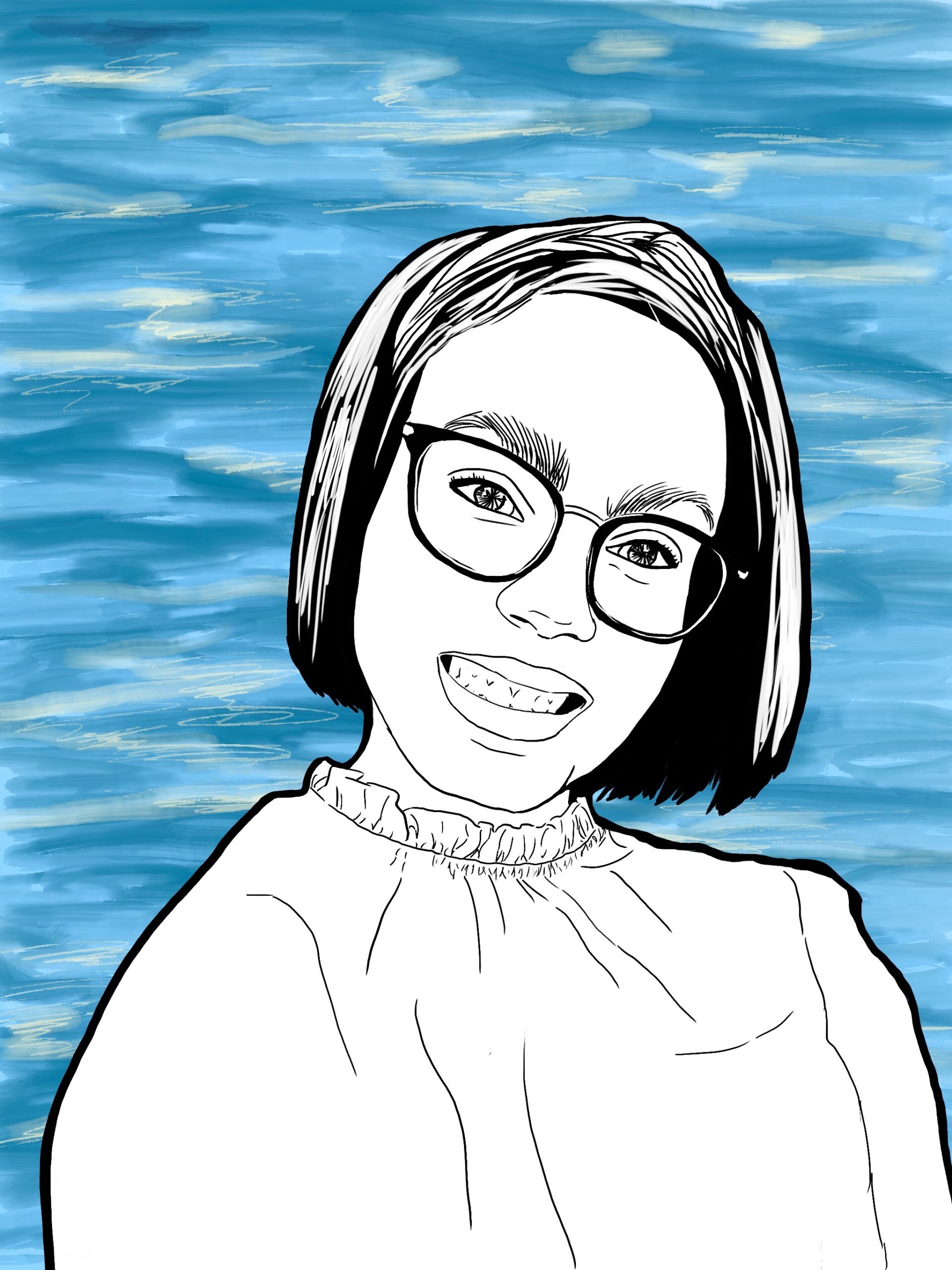
Above: Illustration by Olivia Cohen
Learn More About Ronnie
Ronnie Pessetto is the Executive Director of Seven Canyons Trust, an organization whose goal is to uncover and restore buried or impaired creeks in Salt Lake Valley. Before working at Seven Canyons Trust, Ronnie was a Public Lands Planner for Salt Lake City, where she helped manage various urban parks and trails.
Seven Canyons Trust has several daylighting projects in different stages, which you can read about here. With joy and care, the work of the organization also includes advocacy, education, and community engagement. This year, the Trust celebrates its 10th birthday.
The Backstory of the Three Creeks Confluence
Seven Canyons Trust began in a University of Utah class back in 2014, when a small group of students in an Urban Ecology course developed a 100-year plan for daylighting 21 miles of buried creeks in Salt Lake City. One of the centerpieces of that model was the Three Creeks Confluence, an area just Southwest of downtown Salt Lake City where the “three creeks” (Red Butte, Emigration, and Parsleys) meet the Jordan River. (Confluence is the term for where two or more rivers meet). Within just a few years, the students had had turned the project into a formal nonprofit, secured $3 million in funding, and launched a major daylighting effort. You can read the full original plan (the one they turned in to Professor Stephen Goldsmith) here.
The Three Creeks Confluence quickly became a national model, earning numerous esteemed planning and landscaping awards, and inspiring daylighting projects around the world. It’s also the perfect example of what Ronnie calls “cultural daylighting” in the episode. Water restoration, she says, goes hand in hand with creating accessible and robust community spaces. The Three Creeks Confluence isn’t just a success story in ecological restoration; it’s a public art site, a music venue, and a thriving community gathering space.
If you find yourself in Salt Lake City, you can visit the Three Creeks Confluence at 1300 South and 900 West. See this webpage.
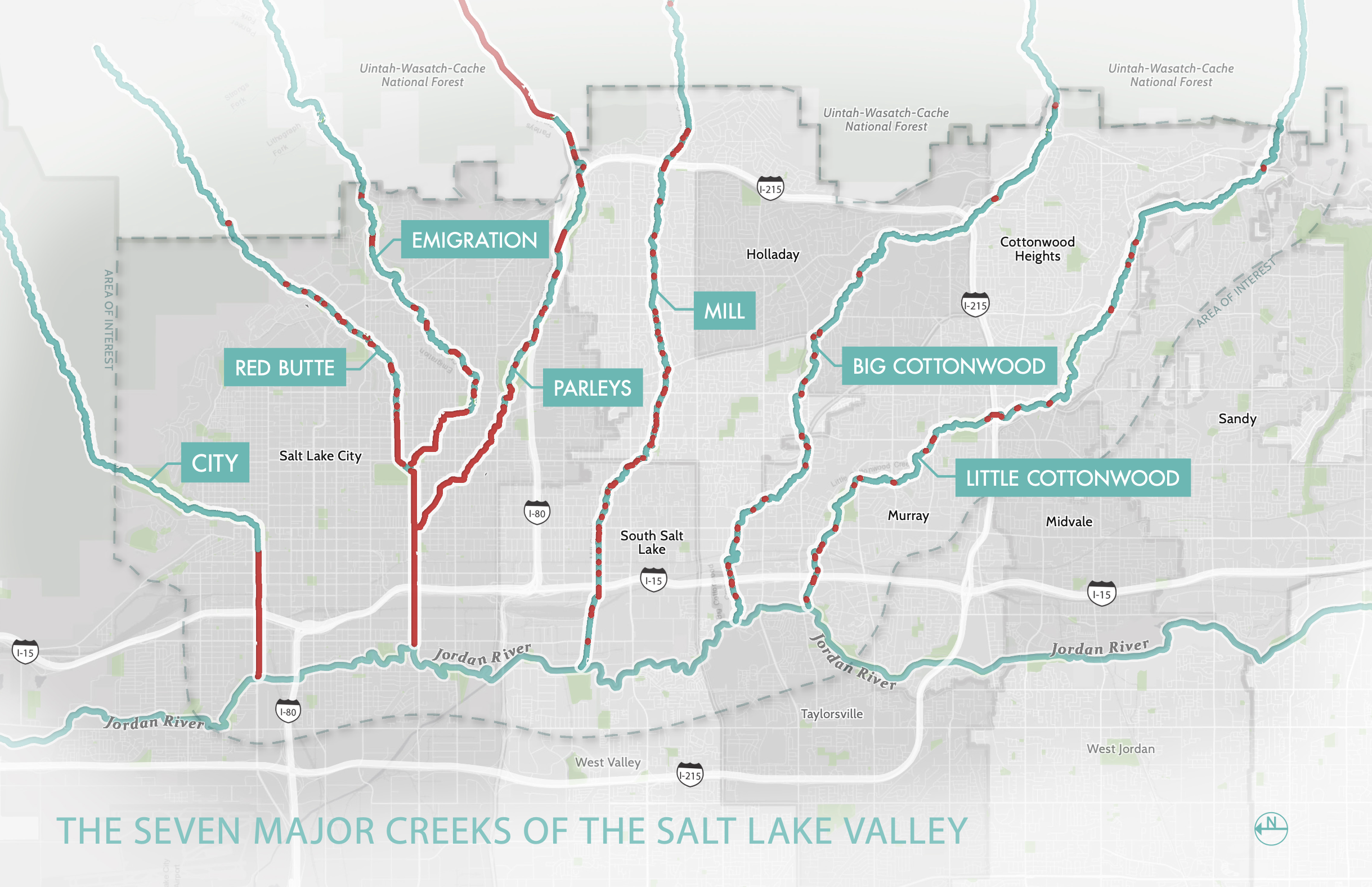
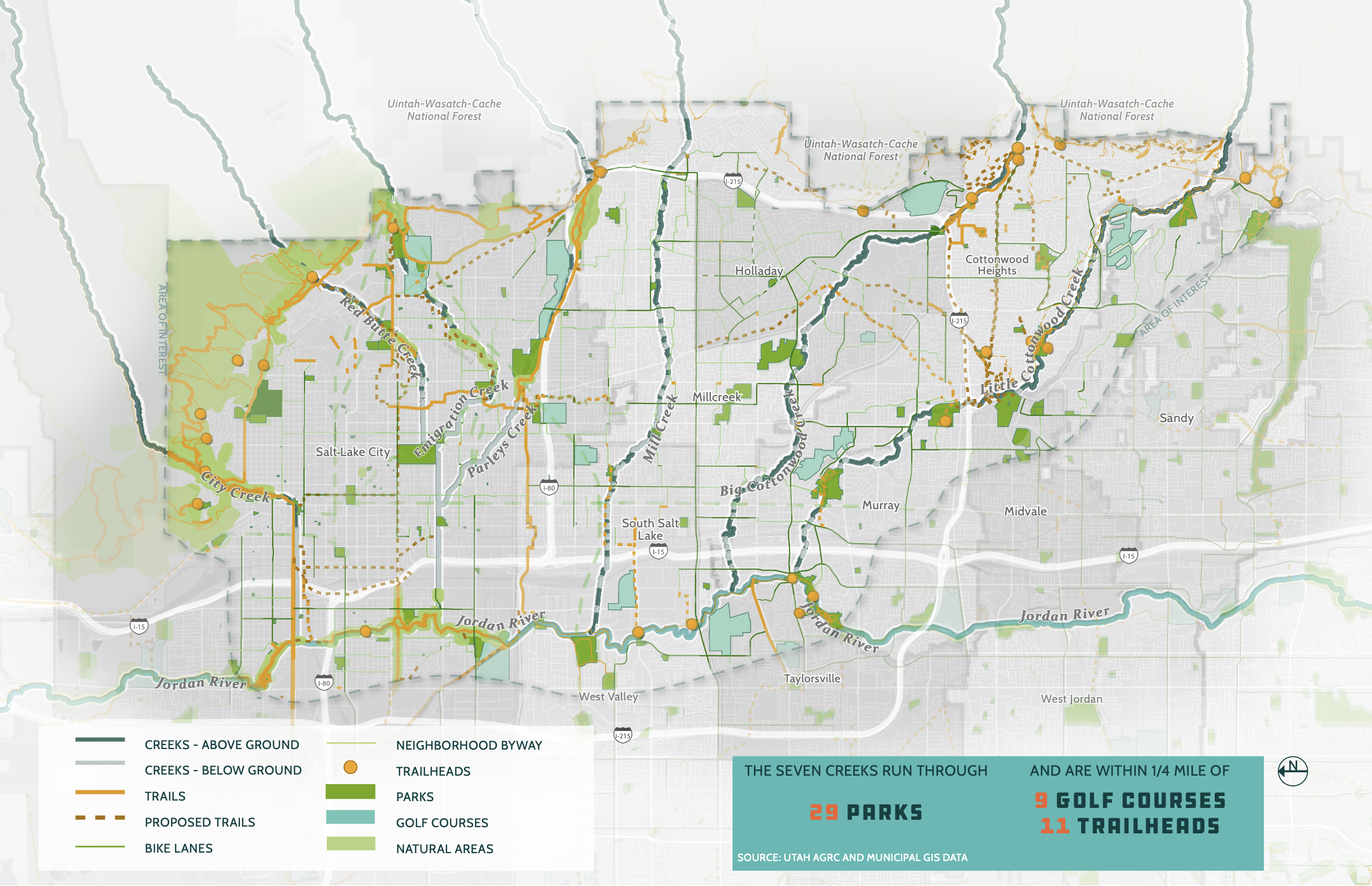
Above, you can see two maps of Salt Lake City. The first shows the Seven Major Creeks of the Salt Lake City Valley. The second highlights where these creeks overlap with recreation in the city – they run through a total of 29 parks! While some sections are still buried, you can see how much of the creeks now flow above ground.
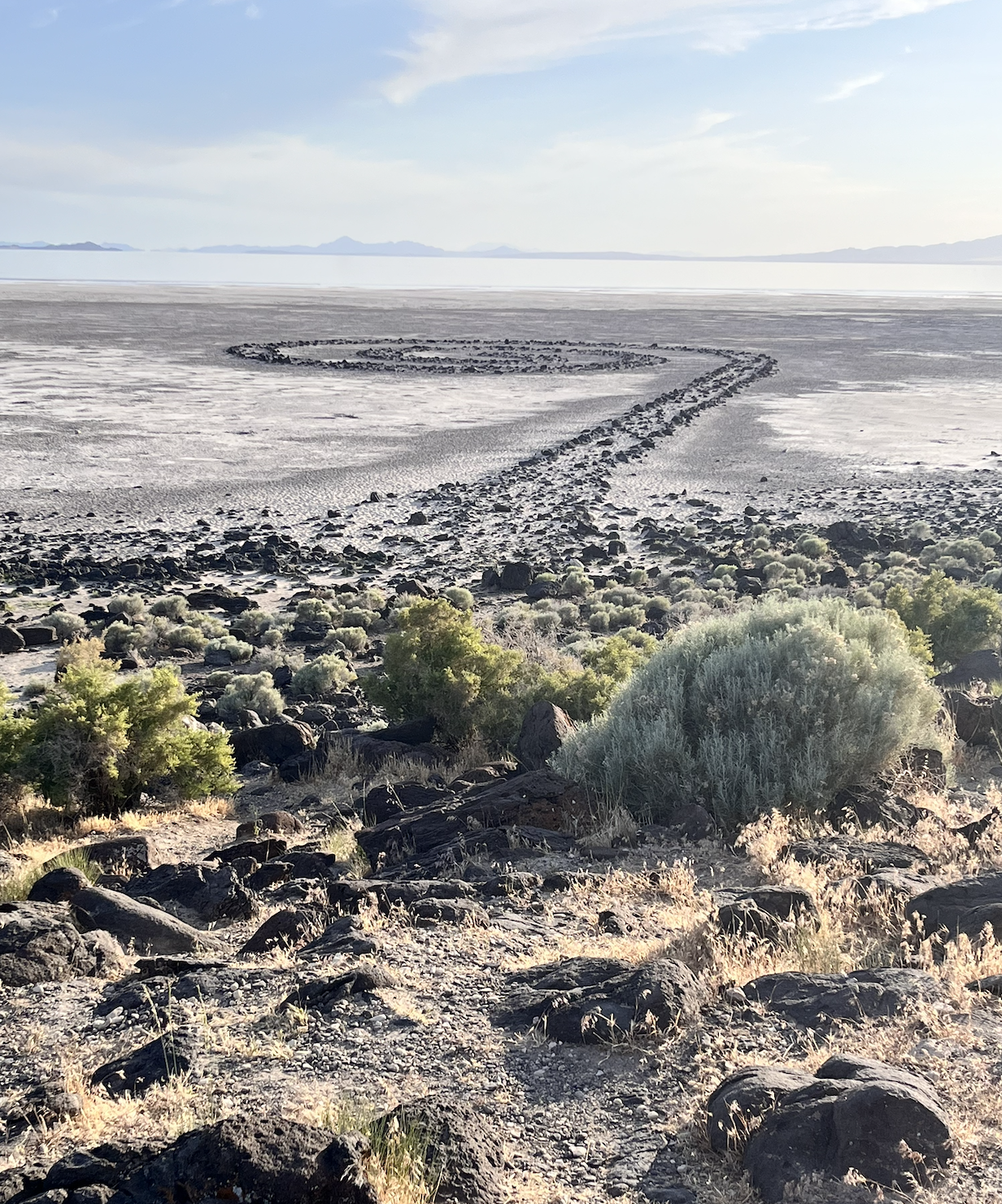
The Spiral Jetty
If you visit Salt Lake City, in addition to looking at daylit rivers, be sure to make the 90-minute drive out to see Robert Smithson’s famous Spiral Jetty. It’s a large-scale earthwork that extends out into the Great Salt Lake, and it’s a truly incredible piece of art. It was built in the 1970s, but not too long after it was completed, the lake’s water levels rose. For 30 years, Spiral Jetty was underwater and unviewable. Then, in the early 2000s, there were times when the water got shallower, and you could partially see Spiral Jetty again — and other times when you couldn’t. Making a pilgrimage was always a gamble! It’s really only been the past decade that it’s been reliably visible. It now sits fully exposed in a lake bed of salt-encrusted sand.
On the drive out there, keep your eyes peeled for long-billed curlews and long-eared jackrabbits hanging out in the grasslands.
Transcript of This Conversation
Jill Riddell: Hello, welcome to The Shape of the World. I’m Jill
Riddell, and this particular episode of The Shape of the World was recorded in
Salt Lake City, Utah. I traveled there to look at a cool project that’s going
on, something that’s very pertinent to our show’s topic of cities and nature: Rivers.
Rivers are relatively rare. Did you know that? It’s kind
of funny to think of rivers that way, especially because most of us live near
one. And the fact that we see rivers a lot makes rivers seem like they actually
are something that’s common and they just aren’t. Of all the water that’s found
on earth, the amount that’s found in rivers is far, far less than even 1%.
Historically, rivers were one of the most important factors determining where
enough people could gather so that eventually there would be enough of us to
build a city, which is why today, so many of us live somewhere near a river.
Rivers provided drinking water, irrigation to grow plants
and crops, and if you had a boat, rivers were fantastic for transportation.
People used them as trade routes. Dry land located next to a river was a
perfect place for a city to come into existence. But I’m bringing this up to
emphasize how special rivers are before I deliver the bad news, which is that
we’ve loved rivers just a little too much. Or maybe I should say over time,
we’ve been demonstrating our love in the wrong way, kind of taken them for
granted. Today when rainfalls in a city, it gets channeled into storm grates
and then into big pipes that are sealed off from our view under asphalt. No one
is going to sit on the grass and have a picnic next to a river like that. But
today we’re talking with someone whose passion and whose job is to try to free
up some of those rivers. Rivers that haven’t seen even so much as a glimmer of
sunshine in a long, long time. The technical term for this free the river’s
action she and others are instigating. It’s called daylighting.
Ronnie Pessetto: My name is Ronnie Pessetto. I live in Salt Lake City and
I am the executive director of Seven Canyons Trust.
Riddell: Welcome to the Shape of the World, Ronnie. It’s good to
have you here. Let’s start with some background on this stream that you and
your collaborators have managed to bring back to life.
Pessetto: So back in the early 1800s, there was a really big
effort to bury a lot of our creeks in the Salt Lake Valley. For that particular
area on the Three Creeks confluence, it was a concrete pipe that tunneled
through the city. Then eventually the water would pour out into the Torton
River corridor. So beneath the parking lot was just a pipe or culvert that had
water flowing underneath it, which is the confluence.
Riddell: So what is the value of having a buried stream? Why did
we generally pave over streams in city? What were the advantages?
Pessetto: The reasoning was to protect the water supply. And for
this particular area and for some other areas across the United States, it was
around the height of the Second Industrial Revolution. So there was a lot of
mines, there was a lot of refineries, digging for oil, steel companies. They
tried to bury them to prevent chemicals entering to their waterways, their
drinking sources, and damaging the aquatic life around it.
Riddell: Wasn’t it also the case that streams were often a public
health hazard, that streams were often used as open sewage ditches before there
were sanitation systems, people would dispose of debris and streams and
sometimes streams would get smelly and foul.
Pessetto: Yes, most certainly. They would throw their sewage and
waste in there and have various different breakouts of cholera and things of
that nature. So that would be another key benefit as to why they winded up
actually having to bury them to keep the sewage and wastewater separate from
these riparian zones.
desire that city planters often have to make a formal grid, streams don’t
really lend themselves to obeying straight lines. I just wonder also a part of
it must have been just so that they would have more land and the places that
they wanted in order to be able to make streets and roads and build buildings.
which is one of the seven creeks that we worked to restore and uncover, was
probably one of the more manipulated creeks out of the seven. They altered the
routes of them to really maximize land use and to utilize the water for
agricultural purposes. So there was definitely a lot of human manipulation to
get it to become beneficial to them. More of an asset than a liability, I guess
you could say.
Riddell: When I think about that time period of the late 19th
century, early part of the 20th century, it was also a time when there was a
lot of optimism about technology and engineering was becoming much better than
it had ever been before. And basically humans for several thousand years had
been at the mercy of whatever water happened to fall from the sky, whatever
stream happened to be present. And now suddenly human beings have the ability
to be able to control that a little bit and to make water on demand and have
water flow where they wanted it to and not overflow its banks and destroy
somebody’s home. I can see where there might’ve been just a lot of innate
fervor to try out all these new tools.
leaning into new ideas at that time. And given the knowledge that they had,
they tried to do the best to protect their community. Now that we have acquired
more knowledge, we’re working to evolve our community in a new way.
one that the Three Creeks confluence, it makes a lot of sense. So who had the
original idea that this parking lot, which didn’t look like much of anything,
could be something completely different and be transformed into a place with
wildlife, an open stream, and people enjoying nature?
University of Utah classroom. We talked about our stream and the necessity to
restore various streams in the Salak Valley. Our previous executive director,
Brian Tonetti, was part of the classroom and actually some of our board members
was part of that classroom. And the instructor, Steven Goldsmith, who is a
board member, actually taught that class.
How did it emerge?
helped out with a daylighting project at City Creek Park, which is a 1990s
daylighting effort. And he has knowledge about the area and its history and its
waterways. And so fast forwarding to 2014, that class was centered around water
restoration and the need for it. And so in that class, they wrote a document
called A Hundred Years of Daylighting, talking about the story of our
waterways, each of the different creeks that supply our needs and take care of
us on a day-to-day basis. And so from there, the students after that class,
they couldn’t have enough of it and they decided to create this organization.
Daylighting.
number one, acknowledges that history of bearing and controlling the flow of
these waterways. The hundred years of daylighting more or less focuses on the
value of actually bringing them back to the surface and restoring them. And
that’s really the sole focus of that plan was in a hundred years, we want to
restore and really daylight these spaces and activate them within a hundred
years time.
past 100 years, but really looking forward to the next century and what could
be changed.
Pessetto: Correct.
Riddell: Oh, no wonder the students got excited. What
happened from there?
Pessetto: So after they finished it, they decided to
create the organization and its first demonstration of the powers of
daylighting was the Three Creek’s Confluence. So while many people in the
community walked by that space on a day-to-day basis, these group of college
students saw it as something so much more than that. They traced down the flow
of these waterways and they found that this space actually had a jewel right
underneath it. And so they reached out to various different council members and
then they loved that idea. And then the council members championed city
administration to pick it up. And from there, we really gathered community
support on it to raise the funds to daylight this space.
those underground waterways and to even know if what wasn’t beneath that piece
of property. Did city engineers already know where the underground
“streams” were?
Pessetto: Yeah. So if you look at the old historic maps,
they actually already have that spacelined out as water flowing beneath it. But
in the hundred years of daylighting plan, it does go into a little bit more
specifics in terms of the status and layout and location of these various
different waterways and how they flow throughout the city in relation to common
roads and things of that nature. So it wasn’t too extensive to be able to find
the location of these water bodies that flow underneath us.
he was hoping that it would actually become something real, or was that the
student enthusiasm that generated that actually happening on the ground?
importance of stream restoration, but I don’t think really any of the students
who entered into that class nor Steven really envisioning that this would
happen, that we would be so moved by this story and the value and importance of
it. No one’s really done and taken on this responsibility before.
They’d identified that location as a possible place to do the daylighting. What
did they do first?
conversation with local council members and really just talked about this
envisioning, which for those who are not familiar with the location of Three
Creeks Confluence, it’s on the west side of Salt Lake City, which is known more
as a lower income area that doesn’t necessarily have as much equitable green
space as I would say as the east side, which is the more prominent side of Salt
Lake City. Them presenting this idea just really ignited a sense of passion and
opportunity that was worth leaning into for this particular council member. And
from there, they just began to work together and communicate with the city
administration and the departments that oversee public spaces. From there, the
council member allocated funding to do more research on this space and do
community engagement and really just reimagine this parking lot as something
so, so much more.
welcome reception right from the beginning. When you and I looked at Three
Creek’s Confluence together before coming into the studio, you told me that
there were two stages in thinking about daylighting, that there’s the
architectural side of daylighting where the actual work is done, but there’s
also the cultural daylighting. Can you describe what you mean by cultural
daylighting?
bringing the creek back to the surface or in its most natural state, which we
love being able to do in architectural daylighting, but with cultural
daylighting, you are uniting and utilizing various different art forms to bring
it to the collective consciousness that water is flowing beneath us, that it’s
present, it’s thriving, and to really view our waterways in a different manner,
view the spaces that we walk past on a day-to-day manner. Water is just such a
really great connector, not just within geographic boundaries, but it’s a
connector for people as well. And so to be able to utilize that value and truth
has been really key in terms of leading us to being able to do that
architectural daylighting and keeping that fire going.
Riddell: Why is water a connector?
us really relies on it. Even the establishment of this modern day city, when
the southers came down into this area, they came for water and they were able
to connect with different tribal members in these water spaces. People have
different ties and stories and experiences and various spectrums of their life
that ties them to it. It’s fascinating to be able to pause and hear the stories
behind certain waterways even now with me like tabling or just talking to
someone, a thought happens for them of, “Oh, I live, for instance, near
Mill Creek and we used to fish here all the time.” And so a story really
unfolds and a tie-in and connection happens. And the more you unveil them, the
more value strikes in terms of maintaining and preserving these spaces.
Riddell: Utah’s the third driest state in the United
States in terms of average annual precipitation. You all only receive 13 inches
of rain each year. What challenges do you face at a conservation organization
somewhere else that’s working on daylighting rivers might not have? And are
there also advantages to being in a community like that, like maybe average
people think more about water here and are a lot more water conscious?
Pessetto: I think we’re definitely growing in the ways of
becoming more water conscious. We’re seeing that our Great Salt Lake is
declining in terms of its water volume. There is a slight disconnection with
that of the lack of care for these particular creeks. When people typically
think of the Great Salt Lake, they think of it as a entity on its own.
Riddell: Oh, they don’t think about what’s flowing into
it.
Pessetto: And it makes it also worse when they’re buried
and you don’t see them.
Riddell: Or we’re such a visual species. We rely on vision
for 70% of all of our input compared with our other senses, and that just makes
a lot of sense that if it’s a complete abstraction, you’re not actually seeing
them flow into the Great Salt Lake. I can see where that would be difficult to
make that connection.
Pessetto: Yeah.
Riddell: What are the climate change projections for Salt
Lake City? What is expected to happen here?
Pessetto: So we actually get a lot of our water from the
Sunocap mountains and they slowly melt throughout the year and then they flow
into these streams that we work to defend in the Salt Lake Valley. And so the
danger as well with the climate change is that if it melts too fast, we won’t
have enough water supply. And that’s not only dangerous to us, but dangerous to
our species. I mentioned earlier that 80% of our species here in the state of
Utah relies on these waterways.
Riddell: Of animals and plants.
Pessetto: Exactly. So if they dry up too soon, then we’re
mid-heat and summer. It gets pretty toasty here and in the state of Utah in the
summer. And so if they melt too fast, we won’t have water. And so our waterways
are starting to dwindle down, so the projection’s not very good.
Riddell: I read that 60% at the very least of the water
that people drink in Salt Lake City comes from that snow melt. And in years
when it’s bountiful, it might be as much as 90% and that you do have some deep
water aquifers to take drinking water from, but it’s small compared to what
you’re expecting just to happen naturally year after year as snow melt. I can
imagine where that would be very sobering to think that that would be
decreasing. So Ronnie, what is your story? How did you get interested in this
subject matter in daylighting and in conservation in general? Did you grow up
in the country? Did you have access to nature as a kid?
Pessetto: Yeah, really great question. So I’m actually
from Kentucky. I’m born and raised a Kentuckian, and there’s lots and lots of
water, in fact, too much water. We typically get flooded out in the spring
season.
Riddell: You must be by a big river then.
Pessetto: Yeah. Right near the Ohio River. In fact, I’m
from Louisville, Kentucky. And so water has just really been a big part of my
life. I used to be very outdoorsy, rode my bikes and played in these creeks and
waterways. Unfortunately, I personally experienced some environmental injustice
and I am a cancer survivor. I had a childhood cancer growing up when I was
about 11 or 12. I was stage three and having that experience of dealing with
that really altered my perception in terms of how I relate with the world and
the impact that I wanted to have. And so initially when I was an undergraduate,
I thought my place was in the medical field, taking care of those kinds of
patients. And the more I kind of dove into my academics, I realized that the
structure of a city and its policies really tell the story in terms of the
struggles and strengths of how people are navigating through their spaces.
And then I thought, well, if I have an impact in terms of
the policies and the way the structure of a city is formed, then maybe I can
prevent people in the first place from experiencing the trauma that I’ve had to
experience from something as innocent as playing in a stream or a waterway. And
so I went ahead and got my bachelor’s degree in environmental policy and then
moved here to Utah to obtain my master’s degree in city in metropolitan
planning. Seven Canyons Trust has always kind of been sprinkled throughout my
career and looking back now, I kind of chuckle because my first year we
actually partnered with Seven Canyons Trust to do a Mill Creek feasibility
study in South Salt Lake City. My second job that I took was with Salt Lake
City working on general obligation bond projects. The city in 2012 actually
received an $85 million bond.
And so I worked on some of those projects and one of those
projects is Falsome Trail and I collaborated with Brian Tonetti, who was the
previous executive director. He was just wrapping up his engagement study and
working on some concept plans for the daylighting effort. And then fast
forwarding today, now I’m the executive director.
Riddell: You were explaining to me that Three Creek’s
confluences on the west side of the city and that there’s definitely a west
side and east side divide. Does your own experience with environmental justice
or injustice in your case help motivate you to want to do more of these kinds
of projects for the people that live on the west side?
Pessetto: For sure. My very first semester, we were
collaborating with the city on creating a master plan for handling and
addressing our open spaces in the city. And I remember we went out and we
collected different surveys, just talking to different people in different
areas of town. And I do remember seeing a drastic difference between the
quality of parks and open spaces at that time and just feeling just so
incredibly upset about that variation difference. The west side actually has
more acreage than the east.
Riddell: Potential open space.
Pessetto: Yes, for open space that really hasn’t been
leaned into as an opportunity. Now I think the city is starting to realize that
opportunity and the importance of giving these spaces the proper allocation
that they need regardless of their location. But I do remember feeling just
incredibly upset and noticing the stark, stark differences between the care and
the attention that Eastside Parks received versus the West Side. And I think
the general obligation bond really allowed to level that platform a little bit
more and give all different parts of the city the opportunity to have equitable
access to green spaces.
Riddell: I’m sure that some of your job is very uplifting. It must
be nice to see these things coming to existence that have been ideas in
people’s minds to actually see them physically occur on the land, but it also
must be hard. Do you have any basic tenets that you live by? Any mottos or
things you repeat to yourself to keep yourself going?
Pessetto: I think a key thing that drives me is
understanding that it took us 20 plus years to get to this point and thus it’s
not going to take a day or even a week. It’s going to take time for us to be
able to get out of this. And so really just taking our time and really
embracing this journey is a really key thing that I really ground myself with
because sometimes there’s just so much pressure to just want to just solve it.
You just want to solve it today. You just want to have that money in hand to
really start getting going, but it took a lot of meticulous collaborative
energy for our spaces to be the way that they are, and it’s going to take that
same energy, if not more, to get out of it. So that kind of grounds me a little
bit in feeling like I don’t need to solve the problem today.
The other thing I would say is when dealing with these
waterways, something that I’ve learned and acquired as a philosophy and way
that I navigate through this line of work, is that place already exist with
these waterways. When you’re uncovering them, you’re not only covering water,
you’re uncovering the stories and the lives and the people that have loved and
touched it. The big scheme in question is whether or not you want to embrace
that, embrace that reality, embrace that place, embrace that story. You’re
uncovering various different stories from the indigenous community or maybe the
surrounding community, and you have the opportunity to make them feel seen in
ways that they haven’t experienced before and feel supported. And so there’s
definitely a healing process with the creeks, but there’s also a healing
process, I argue, for community members that happens when you’re restoring
these spaces. And so being able to take the time out to undergo this process
with them is really key and it’s something that I ground myself with.
Not just breezing past it, let’s just stay like these
spaces and move on, but let’s lean into this a little bit more. Not only in the
way that we treat it and uncovering these spaces, but also establishing a new
sense of community and a new script to read off of in ways that we haven’t done
before.
Riddell: As you were talking about how we got here and how
long things take, it sort of makes the sense then that Professor Goldsmith
talked about that as being a century, right? So we’re 20 years into that
century, another 80 more to go to get this work done.
Pessetto: Yeah, for sure. Like I said, there’s just so
much pressure to feel like you have to solve it all. And in reality, it takes a
whole community to do this work. It does. Like I said, with the Three Creeks
Confluence, yes, we had this vision and we approached various different members
of the community, but it took us coming together as a community to make this
vision come alive and we could have not done it without all of these different
people, from residents to stakeholders, to political figures, city
administrative people. All of these people came together and that is what made
it successful. And so taking a time again to enhance those relationships, it’s
vital. It’s a necessity.
Riddell: I used to work for a group in Chicago called Open
Lands that worked on urban open spaces. And I always remember one of my
coworkers would say, “Well, just because we can say it fast doesn’t mean
we can do it fast.”
Pessetto: Sure. Yeah. It’s based on the idea of moving at
the speed of trust and working with the community through that. Yeah.
Riddell: Moving at the speed of trust. I like that. So you
pay attention to certain things that the rest of us aren’t paying so much
attention to, these underground streams that many of us don’t even know exist,
and also even your thoughts about community as well. Given that set of things,
if there was one thing that you could impress upon people or change or help us
to see that we’re not seeing, what would that be?
Pessetto: Just to be able to take in the various spectrums
of life surrounding us. There are times when I’m near these waterways and
observing just wildlife, I grasp lessons from them. So as much as I’m helping
them, they’re also helping me and navigating this crazy thing called life. And
so when you’re able to pause and think beyond just your individual kind of
circumstance, you’re able to realize this grand scheme of things of not only
human life, but also wildlife. And that kind of alters your priorities of what
kind of needs to be done and how we structure our community. So if that was one
thing, I would just say just that awareness and that grounding of there’s so
much more than what our eyes can possibly envision and the various different
spectrums of life there are.
Riddell: And I hear embedded in that an encouragement
toward a kind of slow, close learning observation noticing.
Pessetto: Yeah. We live in just such a fast-paced world
and we feel like we have to have everything solved and figured out. Moving in
that way, I’m sure it has its perks, but it also has its downsides as well, and
especially in us feeling like we have to have it all together. We have to know
the answer to things. And maybe there’s a joy in having a little bit of mystery
rather than just being so focused on this destination of, I just want to
daylight a creek and just enjoying that journey and discovery of other people,
other life, and really yourself too. And I feel myself, even in the five months
that I’ve been in this position growing in ways that I’ve never imagined, just
from the interactions with people and nature and the creeks. And it’s been a
wonderful journey and I’ve just been trying to embrace that.
And I wish if I could bottle it up into a jar and give it
to people, I would.
Riddell: I do think our culture’s changing a little bit.
I’m thinking also when you talk about that too, of that sort of wanting things
to be done in a hurry, I do think that’s been something that’s been with us for
a long time. And I think about the original people coming into Salt Lake City
and being really quick to pave over streams because that was easy and it got it
done and didn’t have to think about it anymore. That same impulse is with us
now of just to try to solve things fast. And what would it be like to be a
little playful about it? Like, oh, why don’t we cover some of the streams
because we need some of them covered to be able to do this or that and they’re
solving that purpose. But what if we just let some of them be? There is a
movement toward recognizing that.
Pessetto: Yeah. I think when you’re able to slow down a
little bit more and lean in with curiosity, innovation can happen.
Riddell: Right.
Pessetto: A really true innovation where it addresses all
these different values can officially happen. And when you’re moving at a fast
pace, you can’t really pause to think about that and understand all of these
different values and all these different interests and really address them in a
unique way that’s catered to this particular community. And I think that’s
something that’s really special about, that I’m learning about these creeks is
that each of them have their own personalities. They really do in relation to
people in the human hands that have touched it and loved it, to the wildlife
that really loves to be in a particular area, so on and so forth. Like I said,
it’s an incredible opportunity to just slow down, really just embrace it,
embrace all that it has for you.
Riddell: Ronnie, it’s been great talking with you about
Salt Lake City and daylighting rivers. Thank you so much for being on The Shape
of the World.
Pessetto: Thanks so much, Jill. It’s most certainly been a
pleasure sharing space with you and telling the story.
Riddell: This is Jill Riddell. I hope you enjoyed this
conversation with Ronnie Pessetto and that you’ll check out the Seven Canyons
Trust website to learn more about what they are doing and maybe explore whether
there’s a river in your city that could do with a little daylighting. Check our
website as well for more links and some additional history on daylighting that
I think you’ll find interesting. And if you happen to live in Salt Lake City or
if you’re going to be traveling there sometime this year, check out both City
Creek, that first project Ronnie spoke of, and definitely go see the Three
Rivers Confluence Project as well. Also, one more reason to check out our
website, I couldn’t resist, including some other touristy advice on that
webpage, mostly about my making a pilgrimage to visit Spiral Jetty and all the
curlews I saw on the dry of wildlife going out there.
The Shape of the World is about nature, cities, and people
and the world we share. It’s a production of The Office of Modern Composition,
a business that coaches writers and helps people and organizations tell their
stories. If you have something you’re trying to write, the Office of Modern
Composition can help. And even though this time we’ve recorded in Salt Lake
City, the shape of the world is mostly produced in the vital, vigorous, and
beautiful metropolis of Chicago and the Prairie State of Illinois. The shape of
the world is a completely carbon neutral endeavor thanks to reductions we made
and from a carbon offset purchased from Tradewater. If you’re interested in
eliminating your carbon footprint, go to the website tradewater.us. You can
find The Shape of the World on Instagram and Facebook and on our own website,
shapeotheworldshow.com. There you’ll find out more about Ronnie Pessetto, and
you’ll also find a drawing of Ronnie made by the artist, Olivia Cohen.
This episode of The Shape of the World was produced by
Gabby Gladney and mixed by Jeremy Thal. Our theme music was composed by Brad
Wood.. And I’d be remiss if I didn’t also thank my niece, Libby Brown and her
husband, Sam Coldstein. If they hadn’t moved to Salt Lake City and held their
wedding there, I might not have made it out there. This was the first episode
that we’ve ever done on The Shape of the World that examined the different
challenges and opportunities that are faced by cities located in a really arid
environment. So thanks, Libby. Thank you, Sam. And thank you for listening.