

We often notice more of the visual world than we do the auditory world, yet many of our experiences are defined by sound. The memory of a significant summer evening may suddenly be brought back by our hearing the call of a nighthawk, the swoosh of car tires rippling through a puddle, or the tinkle of piano keys coming from an open window.
Even if at the time of the event you didn’t bring a sound fully to your conscious mind…. even if you failed to ponder its source…. still, hearing it at a later date, out of the blue, will jog recollection of a particular place or person, or perhaps a certain time period in your life. We know that music is very powerful that way. But sounds from nature possess the same ability.
And for those of you who grew up in North America, there’s one strong sound from nature that evokes city life in summer: the call of the Common Nighthawk.
“I cannot change what is happening across a continent-wide population. But I can change it here.”
– Edward Warden, President of the Chicago Ornithological Society and Community Stewardship Program Manager at The Nature Conservancy’s Illinois field office.
Learn More About Edward
By day, Edward works at The Nature Conservancy. But by night, Edward is President of the Chicago Ornithological Society (COS), which sponsors the Chicago Nighthawk Project. COS has numerous ongoing initiatives, including urban restoration projects, community science programs, advocacy work, and field trips. They make it incredibly easy for Chicago residents to get involved with all-things-bird. Beyond their community science programs, they host Chicago bird photo contests and are one of the principal organizers of the Chicago Urban Birding Festival, which is happening this year from September 18-20. You can learn more about COS and their programs here.
How Do I See a Nighthawk?
Go outside in the evening from late May through early July. Because cities give them open airspace, warm rooftops, and good acoustics, the sounds of their characteristic “peeent” sound (as imitated by Edward and Jill on the podcast) really carries.
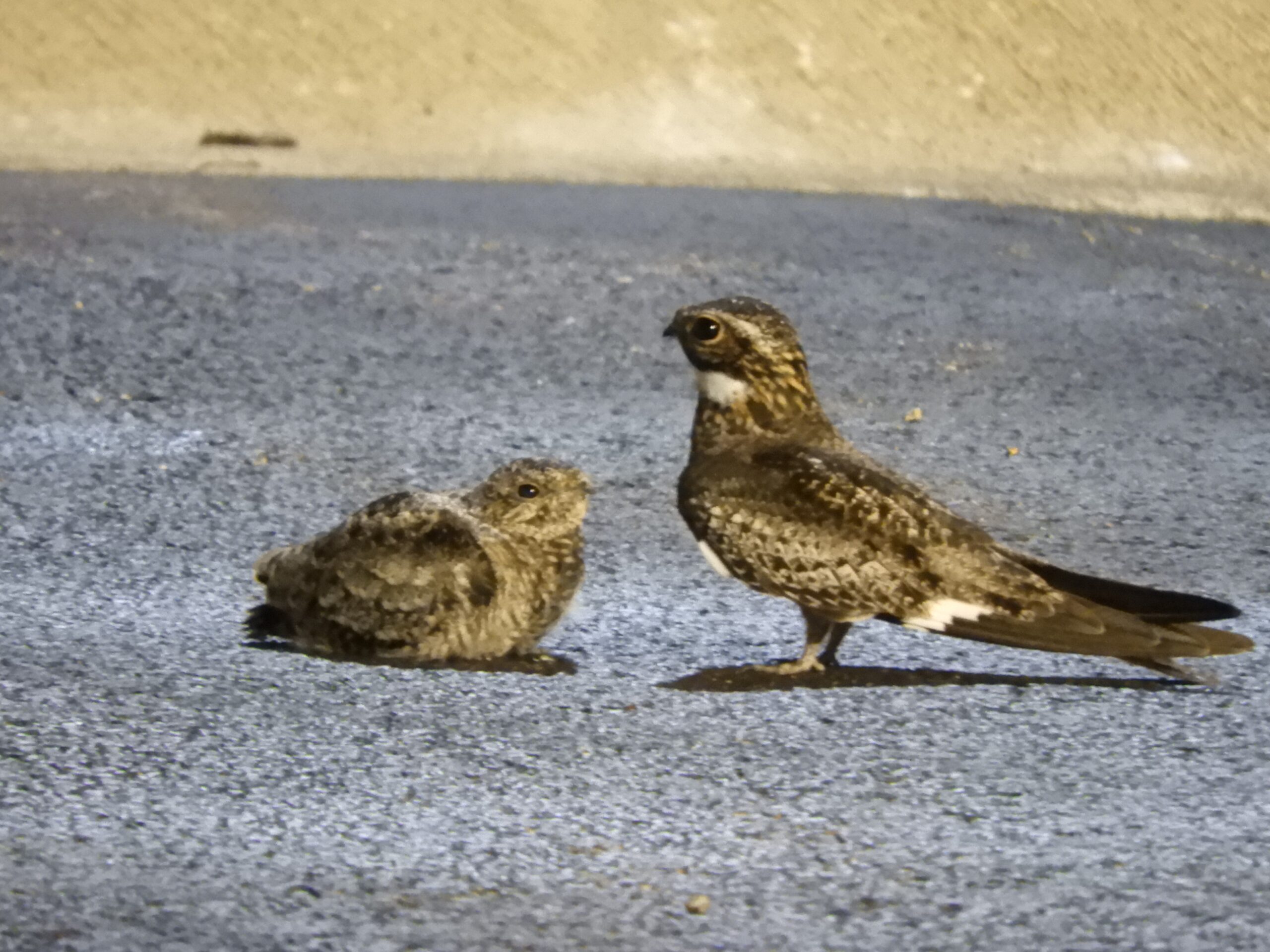
Starting in June and continuing into July, nighthawks nest. But unlike most other birds, they don’t go around picking up dry grass stalks and composing them into a soft little cup for their babies. Nighthawks lay their eggs directly onto flat gravel rooftops. The incubation period is quite short, lasting only about 18-20 days. Once they’re out, the chicks grow fast. By mid to late July, many of the young have fledged and are flying around finding their own dinner.
From August to September, courtship is over, the laying of the eggs is done, and the kids have grown strong. That’s when they head out, head south to Brazil, Bolivia, Argentina, and Paraguay. During the winter, they don’t have to worry about finding gravelly plains so they are less city-centric. If you’re in South America, look for them there in open habitats like savannas, grasslands and agricultural areas.
How Can I Spot One?
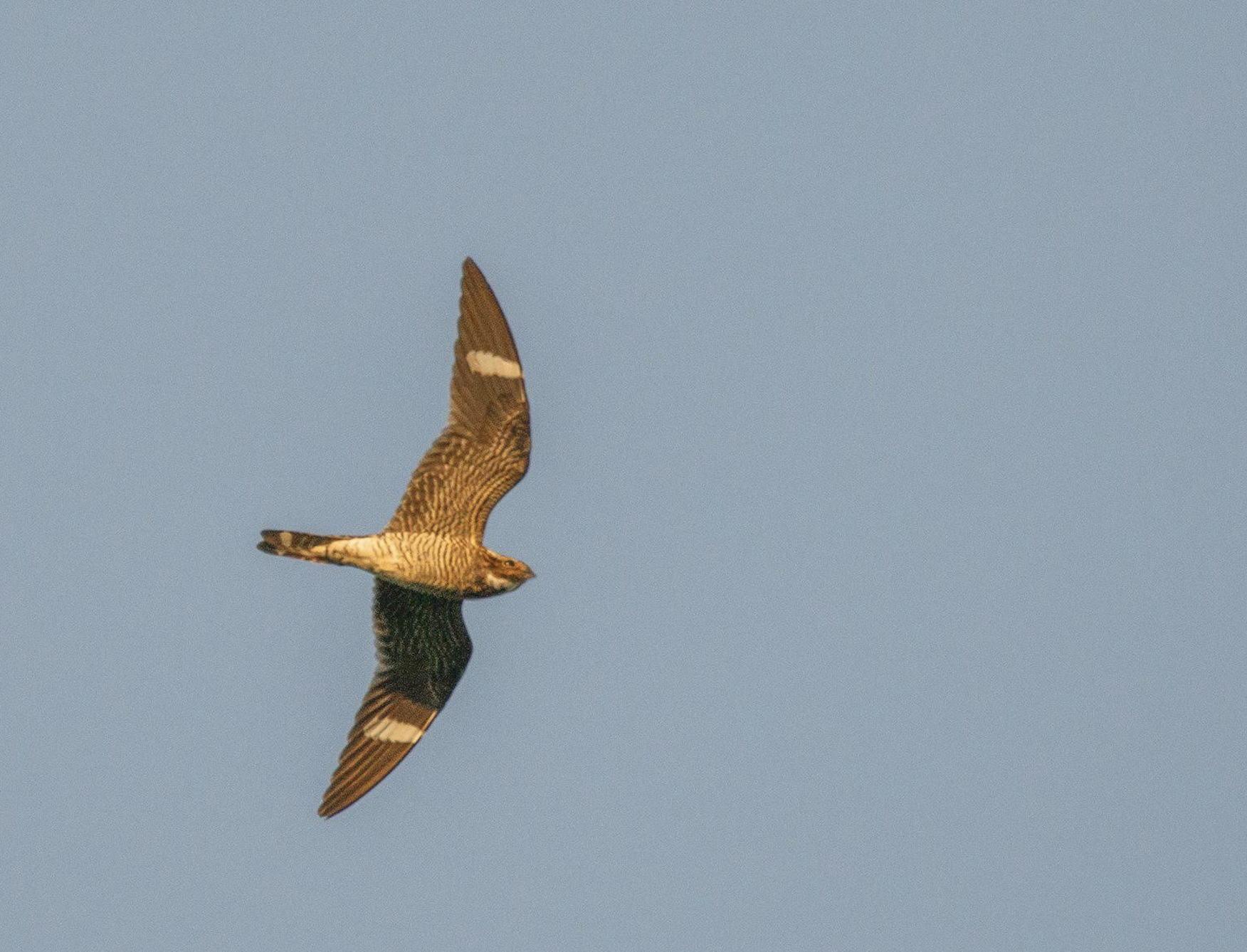
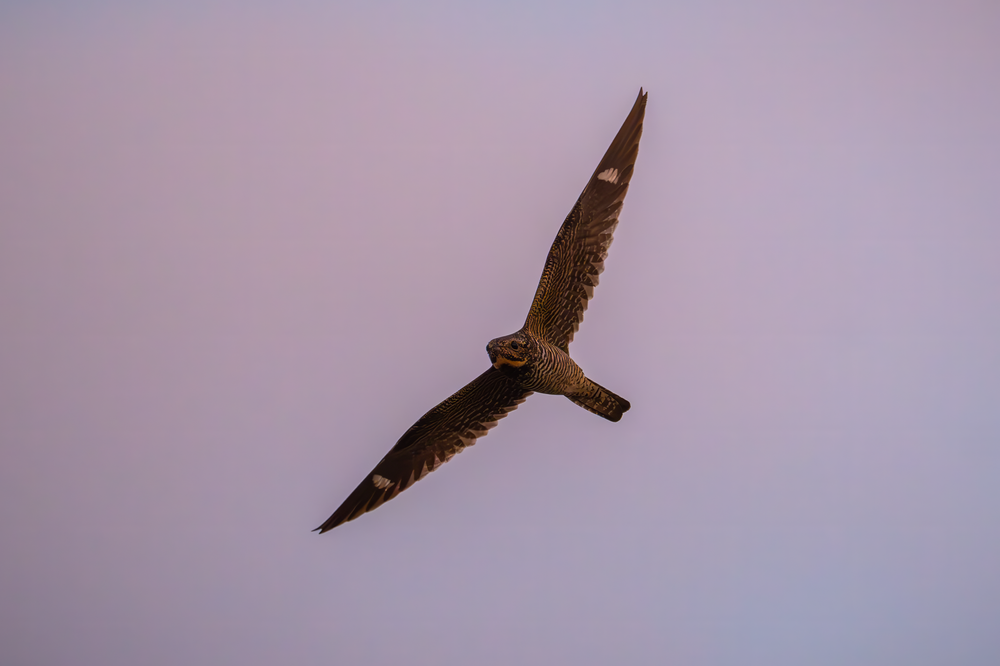
Nighthawk flight patterns resemble those of bats and chimney swifts (their flight pattern looks rather jerky), because they’re all swerving around to catch bugs. But nighthawks have a bigger wing span than bats or chimney swifts do. This makes them look slightly more floaty than those other nocturnal insect eaters.
The most distinctive feature (which you may or not be able to spot depending on the quality of light) is the white spot on the underside of each of their wings.
Can I Help in Some Way to Determine How Nighthawks are Faring? Is there a Monitoring Program?
If you live in Chicago, Illinois: you can help monitor nighthawks this summer. No prior experience with data collection or biology knowledge is needed. In 2025, volunteers monitored 197 different sites across Chicago metropolitan area and made a total of 526 site visits, which was nearly twice as many as the year before. The COS reported that, “nighthawks were seen at 68 of the locations, up from 49 in 2024. All told, the volunteers saw 188 nighthawks, an increase of 54% from the 122 seen in 2024.”
If you’re interested in volunteering (it’s a nice way to go on an evening stroll around your neighborhood), you can send an email to nighthawk@chicagobirder.org.
If you don’t live in Chicago, Illinois: The Cornell Lab of Ornithology is always engaged in community science. If you download their app, “EBird,” you can report nighthawks (and others birds) at any time, without any necessary gear, organizers, or fees. Your sightings will help build a better understanding of nighthawks and their patterns.
Chicago has an exceptionally robust and consistent nighthawk monitering program, but various other programs and watch nights will pop up around the rest of the United States and beyond. Search to see if there is one in your city, or email your state’s chapter of The Nature Conservancy to inquire about any opportunities.
Other Great Nighthawk Resources:
You can see a fantastic display of their boom and peent calls on this video. (Also, read the comments on this; quite amusing.) Nighthawks also take magnificent dives, which come with their own unique vocalizations. Here’s a video that illustrates that.
Edward wrote a wonderful essay on nighthawks in Humans & Nature Press, and you can read it here.
In the episode, Edward mentioned Gretchen Newberry’s book, The Nighthawk’s Evening: Notes of a Field Biologist. Gretchen did her PhD thesis on Nighthawks, and she left her office job to study them full time. You can purchase the book here, or order it through your local bookstore.
Above photo credits left to right: Marion Miller, Matt Zuro, Carlos Manuel.

