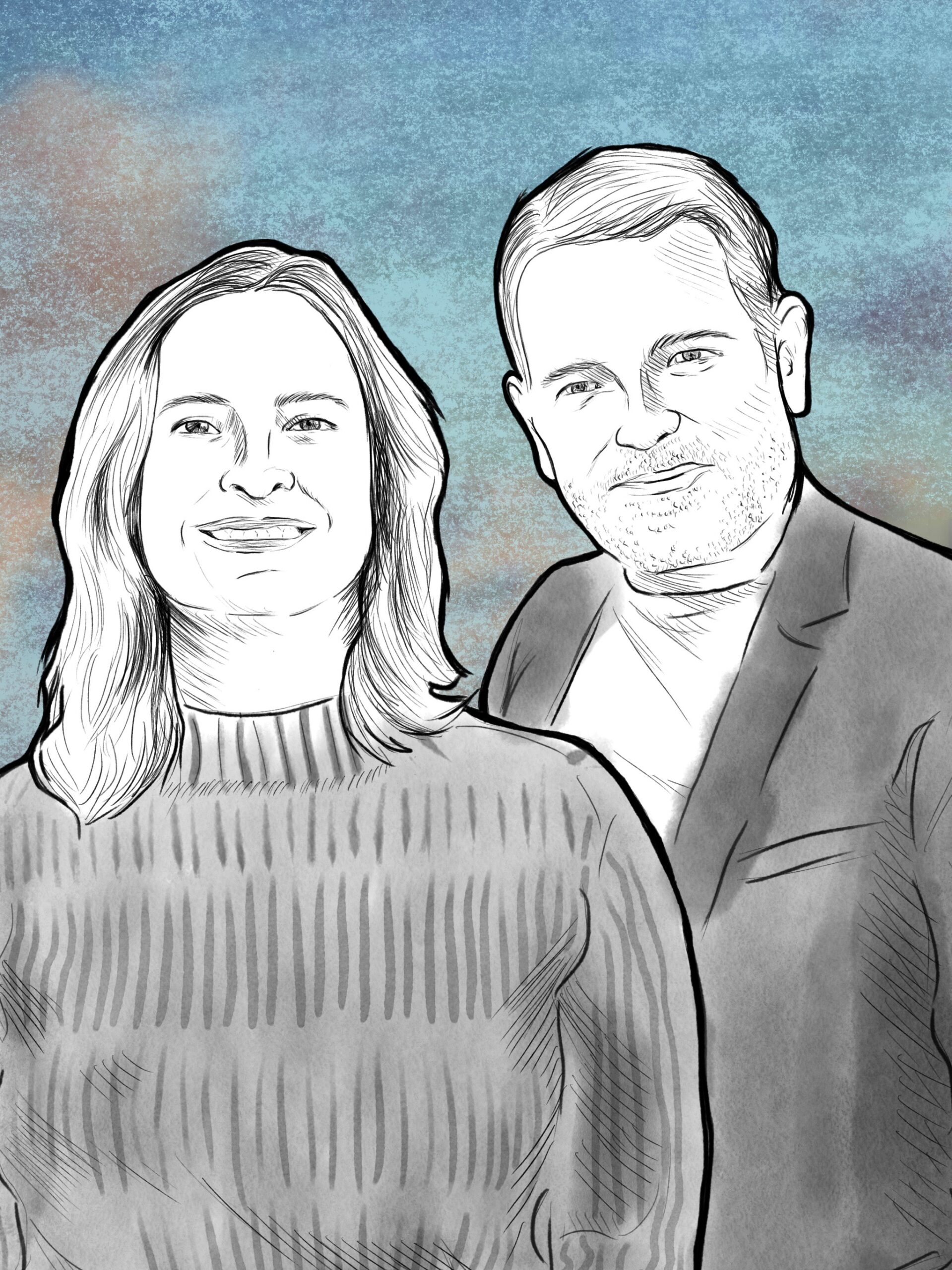
Every single year, millions of birds fly through Chicago as they travel southbound in the fall and northbound in the spring—but buildings make their migration perilous. In this episode, we are joined by Eleanor Esser Gorski, the head of the Chicago Architecture Center, and Michael Davidson, the leader of a nonprofit group called Openlands, to discuss two exhibits currently on view in Chicago that highlight the relationship among birds, architecture, and the urban environment.
Called “Flyway City: Architecture for a Flourishing Ecosystem” and “Chicago’s Living Habitat,” the companion exhibits demonstrate what makes the Chicago region an important stop along the Mississippi Flyway, a critical migration route for North American birds. The guests and host discuss the natural habitats that continue to support birds and other wildlife. Can we make cities that also support these species?
“Birds are global migrants. They’ve been migrating for millennia. They’re stopping in Chicago as they always have. And our cities are kind of in their way, so we owe it to them to make it easy on them.”
– Michael Davidson, President and CEO of Openlands.
About Eleanor Gorski and Michael Davidson
Since 2022, Eleanor Esser Gorski, AIA, has been the President and CEO of the Chicago Architecture Center (CAC), a nonprofit that highlights Chicago’s world-class architecture and urban design through public programming and exhibitions. The CAC celebrates its 60th anniversary in 2026.
Before working for the CAC, Eleanor served as acting commissioner at the Department of Planning and Development for the City of Chicago, spearheaded projects such as the Industrial Corridor Modernization Initiative and the Fulton Market Innovation District Plan.
Michael Davidson is the President and CEO of Openlands, an accredited land trust and one of the nation’s first metropolitan-scale land conservation organizations. Since its inception in 1963, Openlands has protected over 71,100 acres of land in Illinois, Indiana, and Wisconsin and has planted over 12,000 trees in the Chicago region.
Prior to his position at Openlands, Michael worked as the Senior Director of Community Impact at The Chicago Community Trust. There, he led a $100 million strategy to improve economic and development outcomes in majority Black and Latino communities.
About the Exhibits
“Chicago’s Living Habitat” was co-curated by Openlands and the CAC, and “Flyway City: Architecture for a Flourishing Ecosystem” by Studio Gang and the CAC.
Jeanne Gang—founding partner of Studio Gang, Fellow of the American Institute of Architects (FAIA), and Kajima Professor in Practice of Architecture at Harvard University—has been actively studying and seeking solutions to reduce bird collisions with glass. She was a guest on this podcast in 2020.
Due to the strong attendance both exhibits have seen, their run has been extended through April 11th, 2027. Access to the exhibits is included with admission to the Center, which you can purchase tickets to here or at the door.
Support the Chicago Bird-Friendly Building Ordinance
The Chicago Bird-Friendly Building Ordinance is a proposed law that’s currently on the table. It would require bird-safe glass to be installed on the lowest 100 feet of all new commercial buildings, any new residential building that has more than four units, and major renovation projects. If it gets implemented, the law will drastically reduce the number of future bird collisions.
At the release of this episode, 21 council members have signed onto the ordinance, but 26 yes votes are needed for it to pass. If you live in Chicago, contact your alderperson by email (or even better, by phone) and get involved with the Chicago Collision Coalition—both of which you can do here.
Only a few cities and counties in the United States currently have bird-friendly building ordinances. If you live in a place that does not, why not advocate for one in your hometown?
How to Protect Birds Wherever You Live:
If you have a window in your home that’s a frequent bird-killer and want to reduce the number of collisions (or eliminate them altogether, hopefully) then you have an array of options to choose from.
You can purchase Feather Friendly’s bird-safe patterned window decals, or make this pattern yourself using non-toxic tempera paint.
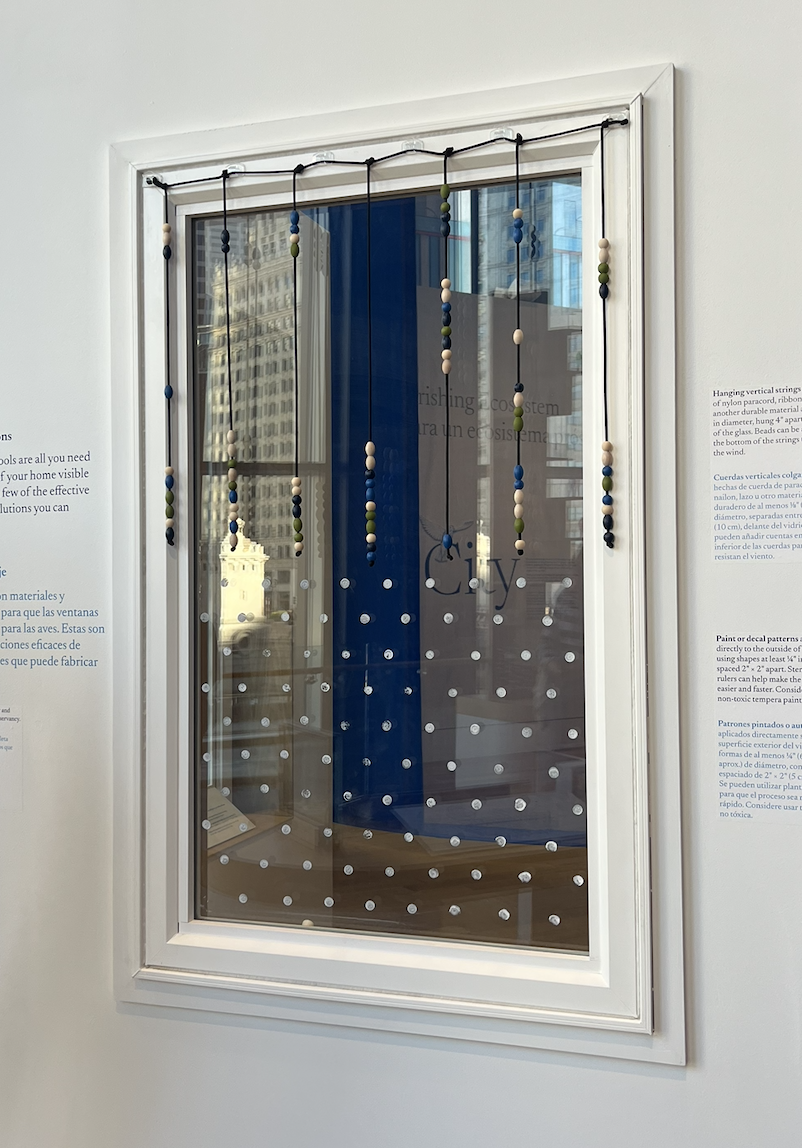
You can also hang strips of durable paracord or ribbon at maximum four inches apart; or use the DIY suggestion that Michael recommended and simply stick up Post-it notes. They only need to be up for six weeks in the spring and again in the fall.
Here is a nice toolkit on DIY solutions, or visit the Flyway City exhibit to learn some more tips.
To the right: an example of DIY bird-friendly glass solutions from the Flyway City exhibit.
More Details About Topics in the Episode
In the episode, Jill mentioned that 20 years ago, she and Jeanne Gang both attended meetings in Chicago City Hall about how to prevent bird collisions. To clarify Jill’s role: she was indeed a participant at those meetings, representing the Peggy Notebaert Nature Museum & Chicago Academy of Sciences where she worked at the time. But she wants to make clear that others in the room were the true leaders of the then-incipient movement to take strong action to reduce bird collisions.
Since that time, many of the organizations involved have changed names or merged with one another, but key players at that time include the Chicago Bird Collision Monitors, founded by Robbie Hunsinger; Chicago Audubon Society; the Fort Dearborn Chapter of the Illinois Audubon Society; and Audubon of the Chicago Region.
Also, it’s accurate to say that a significant amount of credit for progress made in the last two decades rightfully belongs to Jeanne Gang. In addition to running what was at that time an up-and-coming architectural firm, Jeanne made time to personally come to those meetings, both to learn from the bird practitioners present and to offer her own knowledge of glass and buildings. No other architect showed up at the meetings, and there were no representatives from the building community there either in those early days.
More recently, there are new advocates intent on reducing the number of bird deaths caused by glass collisions, like Bird Friendly Chicago.
And, for good measure, although the following groups aren’t specifically leading the fight for bird-friendly glass, here are groups of birders who are active in Chicago: Chicago BIPOC Birders, Chicago Bird Alliance, Chicago Ornithological Society, Feminist Bird Club Chicago, Red Hill Birding, and the Windy City Bird Lab. The Peggy Notebaert Nature Museum is still involved in the fight as well; it hosted the first three Urban Birding Festivals.
Michael mentioned in the episode that one billion birds die every year from window collisions. The actual quote and its source is this: “up to one billion birds die each year from collisions with glass panes in North America alone” (Basilio et al., 2020). Global mortality remains uncertain due to limited research and monitoring. In the Chicago area alone, around 10,000 dead birds are collected annually by Chicago Bird Collision Monitors (CBCM)—a number that’s likely underestimated due to unreported collisions.
Michael also mentioned that Openlands recently received a large grant to continue its restoration efforts at the 20,000-acre Midewin National Tallgrass Prairie located in northeastern Illinois, along Illinois Route 53, approximately 60 miles southwest of Chicago. In 1996, Midewin became the nation’s very first federally designated “national tallgrass prairie.”
Before Midewin’s consecration, there were “national forests” and “national seashores” and “national recreational areas” and even some “national grasslands” in the United States. But it took until 1996 to create a separate designation specifically recognizing the tallgrass prairie as a nationally significant ecosystem. Openlands was a key player in suggesting this new designation and lobbying to make it happen.
Above: Midewin National Tall Grass Prairie. Photo by Madison Smith from the Chicago’s Living Habitat exhibit.